
Energy Star Builders
Shawn & his team at growth key marketing have done an exceptional job bringing my business up to speed with all of the modern tech & automations.
97% Client Retention Rate
Your quote form is not a section of your website. It is your website.It is where every visitor either becomes a booking or disappears — and the standard version, fourteen fields on one page asking for a phone number second, loses most of the people who start it.We rebuilt exactly this for a moving company. Their completion rate went up 147%.
Partner
Meta
Partner
Partner
TikTok
Partner
Partner
Meta
Business Partner
Certified Marketing Partner
TikTok
Marketing Partner
Website design for moving companies is the practice of building the quote flow as the product rather than as a contact form — because a mover cannot be booked by phone alone, and the multi-step estimate request is where nearly every visitor either converts or leaves. It is judged on how much of the form a stranger will actually finish on a phone, whether licensing (USDOT, MC, carrier versus broker) is verifiable on the page, and whether the estimate terms are stated plainly enough to answer the fraud fear the customer arrived with.
Progressive, one decision per screen, the personal details last rather than second. Completion rate is the number this trade lives on and the one a single-page fourteen-field form destroys.
USDOT and MC numbers, carrier or broker stated plainly, insurance and valuation options. This customer already knows the category has a fraud problem and is looking for something they can verify.
Binding, non-binding or not-to-exceed, what changes a price on the day, what deposit is taken and when. The estimate that doubles on moving day is the story every customer has heard.
The gap
A mover cannot be booked from a phone number alone. The customer needs a price, the price needs an inventory, a date and two addresses, and that means your conversion event is a multi-step form a stranger has to be willing to complete on a phone. No other trade in this matrix rests this completely on one piece of interface — which is why the standard failure here is so expensive and so fixable.
The standard failure is always the same: everything on one page, fourteen fields, the phone number in position two so the visitor knows exactly what happens next, and no sense of progress. People abandon it in the first ten seconds and you record it as a traffic shortfall. It is not. It is the form.
What the delay actually costs
Of mobile visits are abandoned past three seconds to usable — and a quote form is the heaviest thing on most moving sites, so the page is slowest exactly where it earns.
Google / SOASTA, 2017
Conversion lift from a 0.1-second mobile speed improvement, around 10% for lead-generation sites in the same study. It compounds with completion rate rather than replacing it.
Deloitte Digital for Google, “Milliseconds Make Millions”, 2020
Every other trade converts on a phone call. You convert on a form — which means your form is not a detail, it is the whole business.
What it's costing you
The mover's visitor arrives already suspicious and already comparing. Both facts change what the site has to do before it asks for anything.
One afternoon, four companies, one shortlist
This is a comparison purchase from the first second — nobody gets one quote for a move. You are not being chosen yet; you are being kept or dropped, and the cost of dropping you is closing a tab.
The customer has read about hostage loads, deposit scams and brokers posing as carriers. They are looking for a USDOT number, an MC number, and a plain statement of whether you own the trucks. Vagueness here is not neutral — it confirms the fear.
And this is where the afternoon is decided. A single page of fourteen fields asking for a phone number in position two tells them exactly what is coming, and a large share leave right there — having wanted the quote.
They are now comparing three companies you are not in. Nothing about your service, your pricing or your reviews was ever evaluated, because the form ended the conversation before any of it was reached.
You did not lose on price or on reviews. You lost at field four, to a customer who wanted to hire you.
What your site has to do
Every one of these is about the same forty-five seconds — the ones between arriving and finishing a quote request.
One decision per screen, visible progress, the easy questions first — where from, where to, when — and the personal details last, once the visitor has invested enough to want their answer. Inventory handled with a room-by-room picker rather than a text box.
This is the change we made for Air1 Moving and Storage, whose quote form completion rose 147%. Asking for a phone number in position two is the single most expensive design decision on a moving website.
USDOT and MC numbers displayed where they can be copied and checked, a plain statement of whether you are a carrier or a broker, insurance and valuation options explained in normal words.
The customer has already read the horror stories. Vagueness reads as evasion, and 'fully licensed and insured' with no numbers is exactly what the companies in those stories also said.
Binding, non-binding or not-to-exceed. What can change the price on the day and what cannot. What deposit is taken and when it is refundable. The estimate that doubled on moving day is the story every customer has heard.
Movers resist this because it reads as inviting scrutiny. In practice it is the strongest differentiator available in a category defined by opacity — you are the one who explained it.
A local move is priced by the hour, booked in days, and decided on availability. A long-distance move is priced by weight and distance, planned weeks out, and decided on trust. Different pages, different flows, different proof.
A single form serving both asks the local customer for a delivery window and the interstate customer for an hourly rate. Neither question makes sense, and the confusion costs completions.
Step-level and field-level abandonment tracking, so you know which question loses people rather than only that people are lost. Then remove or move that question and measure again.
On this trade that is the highest-value report on the whole site. It converts the quote flow from a fixed asset into something that improves every quarter, which is where the compounding gains are.
The proof
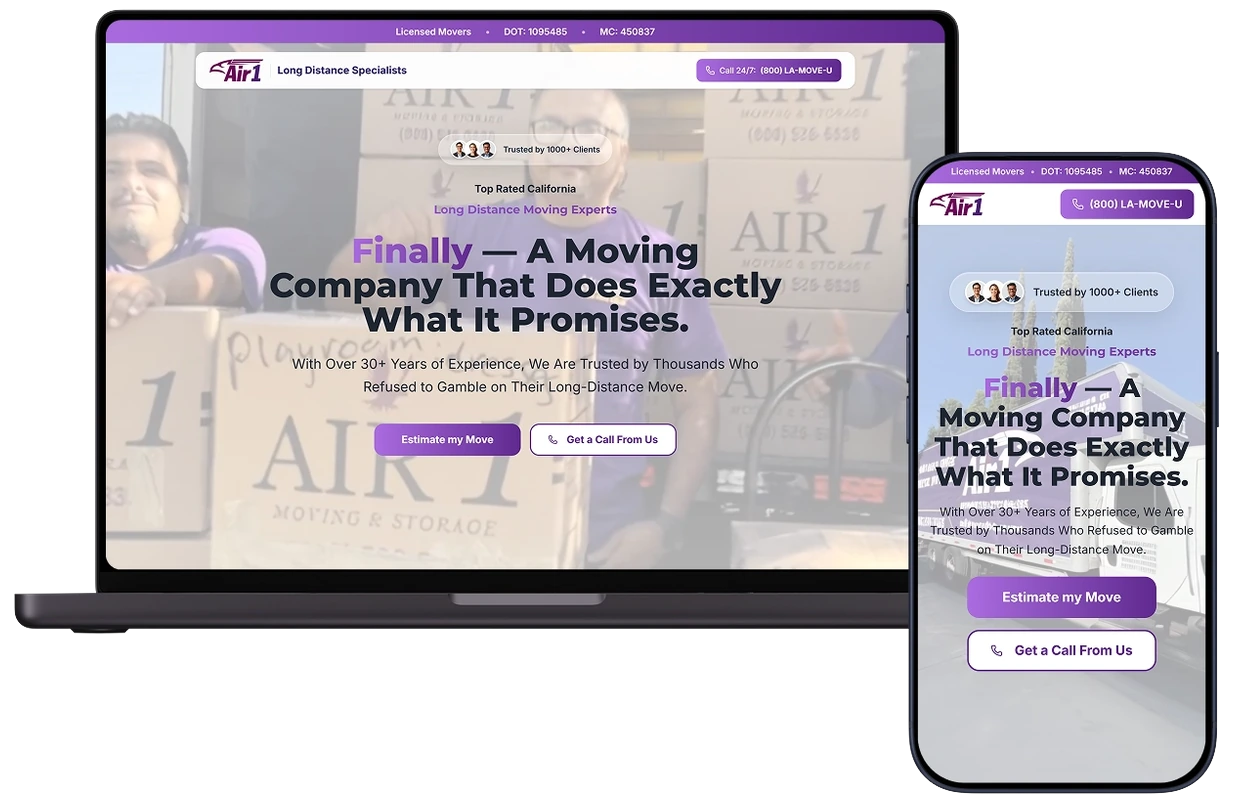
Air1 Moving and Storage
Moving & logistics · Website and quote-flow rebuild
Air1 Moving and Storage came to us for a website and quote-flow rebuild — the exact work this page describes. The figures below are theirs.
Rebuilt the moving quote experience around a shorter, three-step form, live moving-date availability, and clearer pricing. Paired the landing page with Google Ads and Google Business Profile to bring in high-intent moving leads.
Return on ad spend
Increase in leads
Revenue generated
Our Approach
Most agencies start from a WordPress theme. We build every site from scratch in Next.js — so it loads fast, ranks, and is built around getting you calls.
| Compared on | Custom Growth Key buildHand-built. Tuned for leads. | Typical template sitePre-built. Hard to grow. |
|---|---|---|
| Speed | Custom Growth Key buildFast on a phone — built to pass Google’s Core Web Vitals | Typical template siteSlowed down by heavy themes and plug-ins |
| Design | Custom Growth Key buildDesigned around your offer and your customers | Typical template siteBoxed in by the template’s layout |
| Leads | Custom Growth Key buildCalls, forms and tracking built in from day one | Typical template siteBuilt for easy setup, not for bringing in work |
| Upkeep | Custom Growth Key buildClean code — no plug-ins to patch or break | Typical template siteConstant plug-in updates, conflicts and security fixes |
| Growth | Custom Growth Key buildNew services, locations and pages slot straight in | Typical template siteOne-size-fits-all structure that fights every change |
| Ownership | Custom Growth Key buildYou own the code, the domain and the data | Typical template siteLocked to a theme, a page builder or a platform |
How It Works
Six to eight weeks from kickoff to launch. The order is the point — you cannot design a page before deciding what it has to say, and you cannot improve one you never instrumented.
Before anything gets designed we work out what the site has to say and who it has to say it to — your offer, the objections that lose you jobs, and the words your best customers actually use. Most redesigns fail here, not in the design phase: a beautiful page built on a vague message is just a faster way to lose the lead.
Hierarchy before pixels. We map what a visitor sees first, where the proof sits relative to the ask, how many fields stand between interest and a submitted form, and what the call path looks like on a phone. You approve the skeleton while it is still cheap to change.
Hand-coded on a modern stack — no themes, no plug-in stack to maintain, no page builder deciding what your site can do. Fast by construction rather than by later optimization, and yours outright: the design, the content, and the code, with a handoff any developer can pick up.
Tracking is wired before go-live, not bolted on after — form events, call tracking, and the source that produced each one. Then the site stops being a deliverable and becomes a starting position: we watch what real visitors do and rebuild whatever the data says is lying.
What it costs
For movers, this arithmetic is unusually clean, because almost the entire loss happens inside one measurable interface.
| What you already spend to fill the site | $3,000–$20,000/mo | Combined paid search, paid social and SEO for a single-market moving company, with heavy seasonal weighting into summer. All of it arrives at the quote form. |
|---|---|---|
| Quote form completion we usually measure | 25%–40% | Of visitors who begin the form. A fourteen-field single page asking for a phone number early sits at the bottom of that range and sometimes below it. |
| Completion a progressive flow supports | 55%–75% | Same traffic, same questions, different order and pacing. For Air1 Moving and Storage this change produced a published 147% increase in completions. |
| Average local move value | $600–$2,500 | Booked in days, decided largely on availability and price. Volume product, and the one most sensitive to form friction. |
| Average long-distance move value | $3,500–$12,000 | Planned weeks out and decided on trust, which is why the licensing and estimate-terms content earns most of its return here. |
| Extra booked moves the gap is worth, monthly | 10–45 | From traffic already arriving. This is the figure the rebuild has to beat and on this trade it is rarely a close call. |
Completion and conversion ranges are what we observe across moving accounts we audit, not published research; the Air1 figures are that client's own published results and are shown with their name attached rather than as a general claim. Local-versus-interstate mix moves everything here, and a broker's economics are different again.
Why us
We have rebuilt a mover's quote flow before and published what happened, which means this page is arguing from a result rather than from a theory.
Progressive, one decision per screen, personal details last. For Air1 Moving and Storage that change produced a published 147% increase in form completions.
You learn which question loses people, not just that people are lost. That is what turns the flow into something that keeps improving after launch.
USDOT, MC, carrier or broker, valuation options. This customer is looking for something they can verify, and vagueness reads as evasion.
In a category defined by opacity, being the company that explained it first is the cheapest differentiation available.
Design, content, code, hosting, analytics. No builder licence, no lock-in, nothing kept as leverage.
$30M+
In ad spend managed
4.8×
Average ROAS, active accounts
40+
Service businesses scaled
100+
Performance campaigns delivered
The offer
Start with a free website audit. We'll show you where your current site loses people — the pages they leave from, the friction in the form, what it costs on mobile — and what a rebuild would and would not fix. No commitment, yours to keep.
Energy Star Builders
Shawn & his team at growth key marketing have done an exceptional job bringing my business up to speed with all of the modern tech & automations.
Koalaty Remodel
My vision came alive effortlessly. Their blend of casual and professional approach made the process a breeze. Creativity flowed, and the results were beyond my expectations.
Lumiere Catering
Working with Growth Key Marketing has been a fantastic experience! They helped me set up Facebook Ads that actually work. I was blown away by how quickly the ads started bringing i...
Air1 Moving and Storage
It was an absolute pleasure working with them to create a website that truly reflects the quality and professionalism of their moving and storage business. We're thrilled to hear that the new site is making such a big difference! Our goal is always to deliver a seamless experience—both for our clients and their customers—so it's amazing to know that their new website is not only looking great but also helping build credibility and improve functionality. We truly appreciate their trust in GrowthKey, and we're here whenever they need us. Wishing them continued success! 🚀
Space Production
Growth Key Marketing completely transformed our lead generation. Their targeted Facebook campaigns delivered high-quality inquiries almost immediately, and the ROI has been outstanding from day one. Highly recommend their expertise!
NAVA Management
The team at Growth Key took our outdated online presence and turned it into a sleek, high-converting website with smart automations. Leads are coming in consistently now—it's made running the business so much smoother. Truly impressed!
Alluna Dental
We partnered with Growth Key for both website redesign and ongoing digital marketing. The new site looks professional and patient-friendly, while their Facebook ad strategy brought in a steady stream of new appointments. Excellent communication and real results!
CIG Law
Growth Key Marketing nailed our rebranding and online marketing needs. From custom automations that save us hours every week to effective ad campaigns that attract the right clients, they've been a game-changer for our firm. Professional, creative, and dependable.
Move Happy Moving
I can't say enough good things about working with Shawn and the Growth Key team. They built us a modern website that showcases our services perfectly and set up automations for inquiries and follow-ups. Our online bookings have doubled—worth every penny!
FAQ
Straight answers about rebuilding a moving company website — quote flows, licensing, estimates, and what it will not fix.
Because it is the conversion event. A mover cannot be booked from a phone number alone — the customer needs a price, and the price needs an inventory, a date and two addresses. No other trade we build for rests this completely on one piece of interface, which is why the standard fourteen-field single page is so expensive.
One decision per screen instead of fourteen fields at once, visible progress, the easy questions first — where from, where to, when — and personal details last, once the visitor has invested enough to want their answer. Inventory becomes a room-by-room picker rather than a text box. We made exactly this change for Air1 Moving and Storage and their completion rate rose 147%.
No, and it is the single most expensive design decision on most moving websites. A phone number in position two tells a suspicious stranger precisely what happens next and a large share of them leave — people who wanted the quote. Ask for it last, when they want their answer more than they want to avoid the call.
Prominently, and where they can be copied and checked. This customer has read about hostage loads and deposit scams and is actively looking for something verifiable. 'Fully licensed and insured' with no numbers is exactly what the companies in those stories also said.
Yes — binding, non-binding or not-to-exceed, what can change the price on the day, and what deposit is taken. Movers resist this because it feels like inviting scrutiny. In a category defined by opacity it is the strongest differentiator available: you are the company that explained it before being asked.
Yes. Local is hourly, booked in days, decided on availability; long-distance is weight-and-distance, planned weeks out, decided on trust. One form serving both asks the local customer for a delivery window and the interstate customer for an hourly rate — neither question makes sense, and the confusion costs completions.
Yes. Quote submissions feed the moving software you already run — SmartMoving, MoveitPro, Supermove, Elromco and the common alternatives — so a completed form becomes a lead and a job record rather than an email somebody re-keys at seven in the morning.
Not by itself. It changes what happens to the traffic you already have — and on this trade an unusually large share of that traffic is currently lost inside one form, which makes the rebuild's return unusually easy to calculate in advance.
Six to eight weeks, and the quote flow takes the largest share of it because it is designed, built and tested as its own product. We aim to have it live before your summer peak rather than during it.
It depends on scope — quote flow complexity, local versus interstate, integrations — and we quote after the audit. The number to establish first is your current form completion rate, because that single figure usually settles whether the rebuild is worth doing.
Entirely. Design, content, code, hosting and the analytics account, transferable on the day you ask. No proprietary builder, no licence that stops working if you leave.
Field-level and step-level abandonment tracking on the quote flow, wired before launch. You see which question loses people rather than only that people are lost — which turns the form from a fixed asset into something that improves every quarter.
More for moving companies
A free website audit: your real form completion rate, the exact field people abandon at, whether your licensing is verifiable on the page, and how many booked moves a month the gap is worth — no commitment, yours to keep.
No pitch deck. Clients average 4.8× ROAS.


