Google Ads / Strategy
How to choose a Google Ads agency: 12 questions and 7 red flags
Every agency site makes the same promises. These are the questions that separate a partner who will grow your business from one who will grow your ad budget — written by an agency willing to name the red flags.
In this article
Why this decision is so hard to research
Open six agency websites and you will read the same six sentences. Everyone is data-driven, everyone is ROI-focused, everyone is a Google Partner. The certifications are real but close to meaningless as a filter — the badge requires spend thresholds and a multiple-choice exam, not results. The case studies are true and also self-selected; nobody publishes the account they lost.
So the useful signal is not on the website. It is in what happens when you ask specific questions on a call, and in whether the answers stay specific. Below are the twelve we would want asked of us, and the seven answers that should end the conversation.
Ownership and access — ask these first
These three decide what you keep if the relationship ends, which is why they belong at the start rather than buried in month eleven.
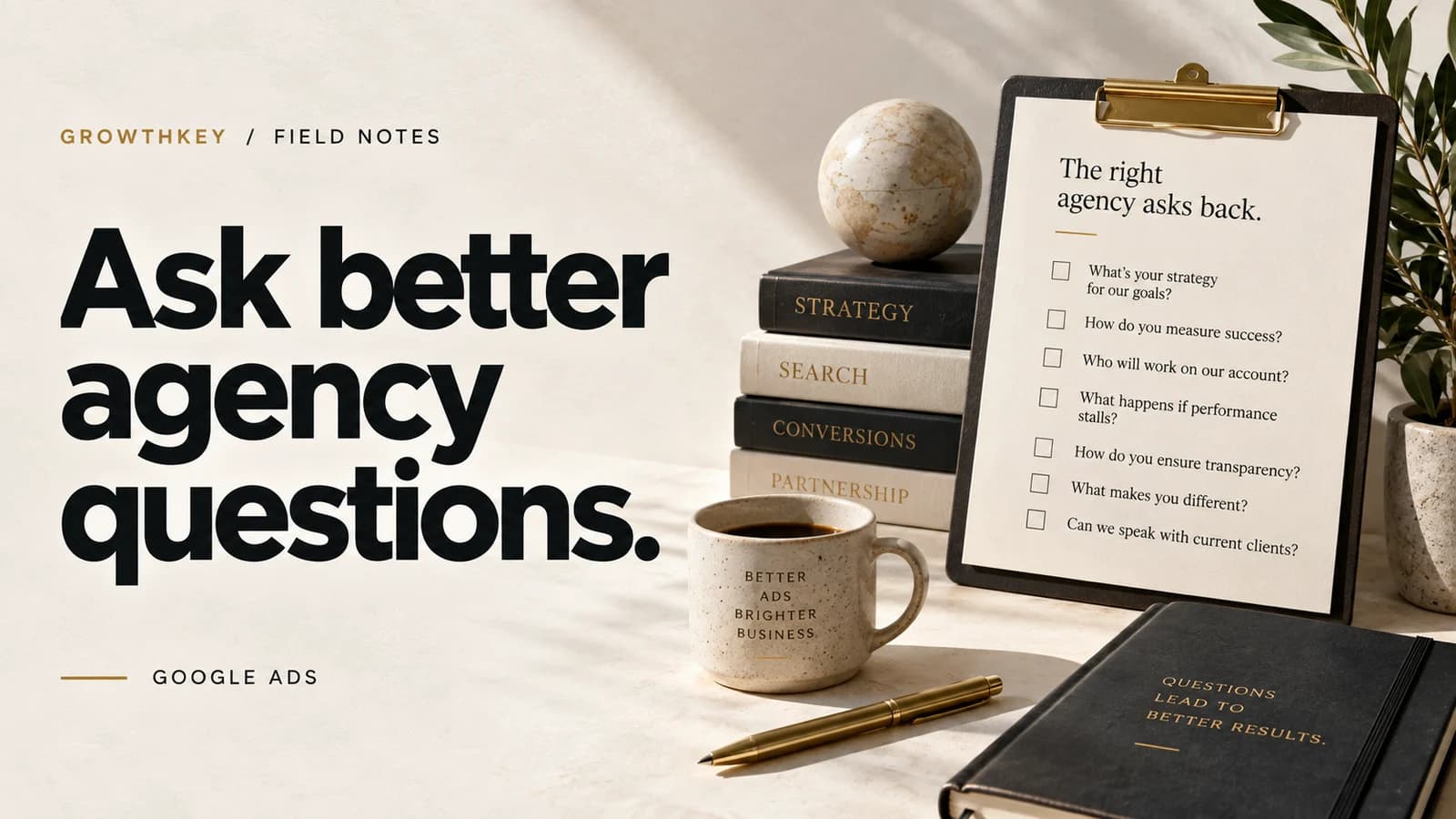
- 1. Who owns the Google Ads account? the correct answer is you. The account should live under your billing, with the agency granted access — not the reverse. Agencies that run clients inside their own account keep the entire performance history when you leave, and years of conversion data is the most valuable asset an account has.
- 2. What exactly do I keep if we part ways? ad account, conversion history, landing pages, tracking configuration, creative files, call-tracking numbers. Get the list before you sign. "We would transfer everything" is a good answer; a pause is an answer too.
- 3. Will I have live access, or only reports? you should be able to open the account yourself and look at anything, any day. An agency that reports on a system you cannot inspect is asking for a trust it has not yet earned.
Measurement — where most engagements quietly fail
An agency can be excellent at Google Ads and still lose you money if the scoreboard is wrong. These three questions test whether they measure the business or the platform.
- 4. What number will we judge this on in month six? the answer you want involves booked jobs or revenue. "Leads" is acceptable only with a definition attached. Impressions, clicks, and click-through rate as headline metrics mean you will be shown a good report during a bad quarter.
- 5. How will you track calls, and who owns the numbers? most service-business conversions are phone calls. If call tracking is not in the plan, nothing downstream is measurable — and the tracking numbers should be portable, not the agency’s.
- 6. Can you push my booked jobs back into Google? the difference between an account optimizing toward form fills and one optimizing toward customers is offline conversion import. Ask whether they have done it before and what it needs from your CRM. A blank look here caps how good the account can get.
The work itself
Three questions that reveal whether there is a real operating rhythm behind the proposal.
- 7. Show me a search terms report from a live account. redacted is fine. You are checking that they look at what people actually typed, and that negatives are being added continuously rather than in a one-off launch pass. This single request separates managed accounts from parked ones.
- 8. Where will my traffic land, and who builds it? if the answer is your existing homepage, expect to pay for clicks that convert at a fraction of what they should. Ask whether dedicated landing pages are included, extra, or absent.
- 9. Who actually touches my account day to day? you will be sold by a senior person. Find out whether that is who runs the work, and ask to meet them before signing rather than after.
The relationship
And three about how it will feel to work with them once the pitch is over.
- 10. What is the fee, what is the term, and how do I leave? flat, percentage, or performance — each is defensible, but you should know which one you are buying and what it rewards. The fee models are unpacked here.
- 11. Tell me about a client this did not work for. the best question on the list. Every agency has them. An honest answer describes the mismatch — wrong economics, no capacity to answer calls, a market too small — and that answer tells you they can recognise a bad fit, which is what protects you from becoming one.
- 12. What would you tell me not to spend money on? an agency that recommends every channel it sells is selling, not advising. We regularly tell businesses under a certain spend level to fix their Business Profile and run Local Services Ads before touching search — because at that budget, that is what works.
Seven red flags
Any one of these justifies walking. Several together mean the model is built on churn rather than results.
| What you hear | Why it is a problem |
|---|---|
| "We’ll run it in our account" | You lose the conversion history when you leave. The switching cost is the product. |
| "We guarantee X leads" or "guaranteed #1 on Google" | Nobody can guarantee auction outcomes. A lead guarantee is met by loosening targeting until the count is hit. |
| Reports lead with impressions, clicks, or CTR | Metrics chosen because they always look fine. Ask what they cost per booked job and watch the pivot. |
| A 12-month contract with no exit clause | Confidence in results does not require a lock-in. The lock-in exists for the months when results are absent. |
| Reluctance to show the search terms report | Either they have not looked at it, or they have and would rather you did not. |
| Every meeting ends with "increase the budget" | Especially on percent-of-spend pricing, where a larger budget is also a larger invoice. |
| They quote before asking your average ticket or close rate | A budget that is not derived from your economics is a guess dressed as a plan. |
The single best predictor of fit
It is not the pitch deck, the client logos, or the certifications. It is whether they ask about your business before quoting a number.
An agency that asks what a job is worth, how many you close out of ten qualified calls, how fast the phone gets answered, and how many jobs your crews can actually absorb next month is building a plan from your constraints. An agency that opens with a package price is selling a product and hoping you fit it. The first conversation reveals which one you are in — you will know inside fifteen minutes.
That is also the whole shape of our free audit: we look at your live account, your real click costs, and your close rate, and tell you what we would change — including, on a fair number of those calls, that you do not need us yet. If that is the conversation you want, start there. If you want to see how we work before you talk to anyone, the Method is written down.
Frequently asked questions
What questions should I ask a Google Ads agency before hiring them?
Start with ownership: who owns the ad account, and what do I keep if we part ways. Then measurement: what number will we judge this on in month six, how will calls be tracked, and can booked jobs be pushed back into Google. Then the work: show me a search terms report, where will traffic land, and who touches the account daily. Finish with the fee, the term, and a client it did not work for.
Does a Google Partner badge mean an agency is good?
It means they meet spend thresholds, maintain certifications, and keep accounts in reasonable standing. It is a floor, not a signal of skill — a large share of agencies hold it. Treat it as a box to tick and then ignore it, because it will not distinguish between two candidates who both have it.
Should the agency own my Google Ads account?
No. The account should be yours, billed to your card, with the agency granted user access. Accounts held inside an agency’s own structure keep years of conversion history when the relationship ends, which forces a new agency to start the learning period from zero — a switching cost that has nothing to do with the quality of the work.
Is it a bad sign if an agency will not guarantee results?
The opposite. Google Ads is an auction against competitors who also change their bids, so no honest agency can guarantee a lead count or a ranking position. A guarantee is either meaningless or is met by loosening targeting until the number is reached. What an agency can commit to is process, cadence, transparency, and the metric you will both be judged on.
How long before I should expect results from a new agency?
Two to four weeks for tracking and structure to be right, four to eight weeks for enough conversion data to make real decisions, and around three months before trend lines mean anything. Anyone promising transformation in thirty days is describing luck. Anyone asking for a year before the first honest read is stalling.
Are your leads becoming customers?
Let’s review your campaigns, tracking, and the steps between a click and a customer. Get a clear view of what to fix first.
- Your business, your numbers
- Practical next steps
- A conversation with our team
No commitment. Yours to keep.