Conversion / Website Design
Do you need a new website, or just a landing page?
The most expensive answer is usually the wrong one. How to tell which problem you actually have — and what each fixes.
In this article
Two different problems that look identical
The symptom is always the same: "we're spending on ads and not booking enough jobs — I think we need a new website." Sometimes that is right. More often the site is fine for the job it does and the campaign has nowhere good to land. The two cost very different amounts, take very different timelines, and fix different things, so it is worth ten minutes to tell them apart.
What each one is for
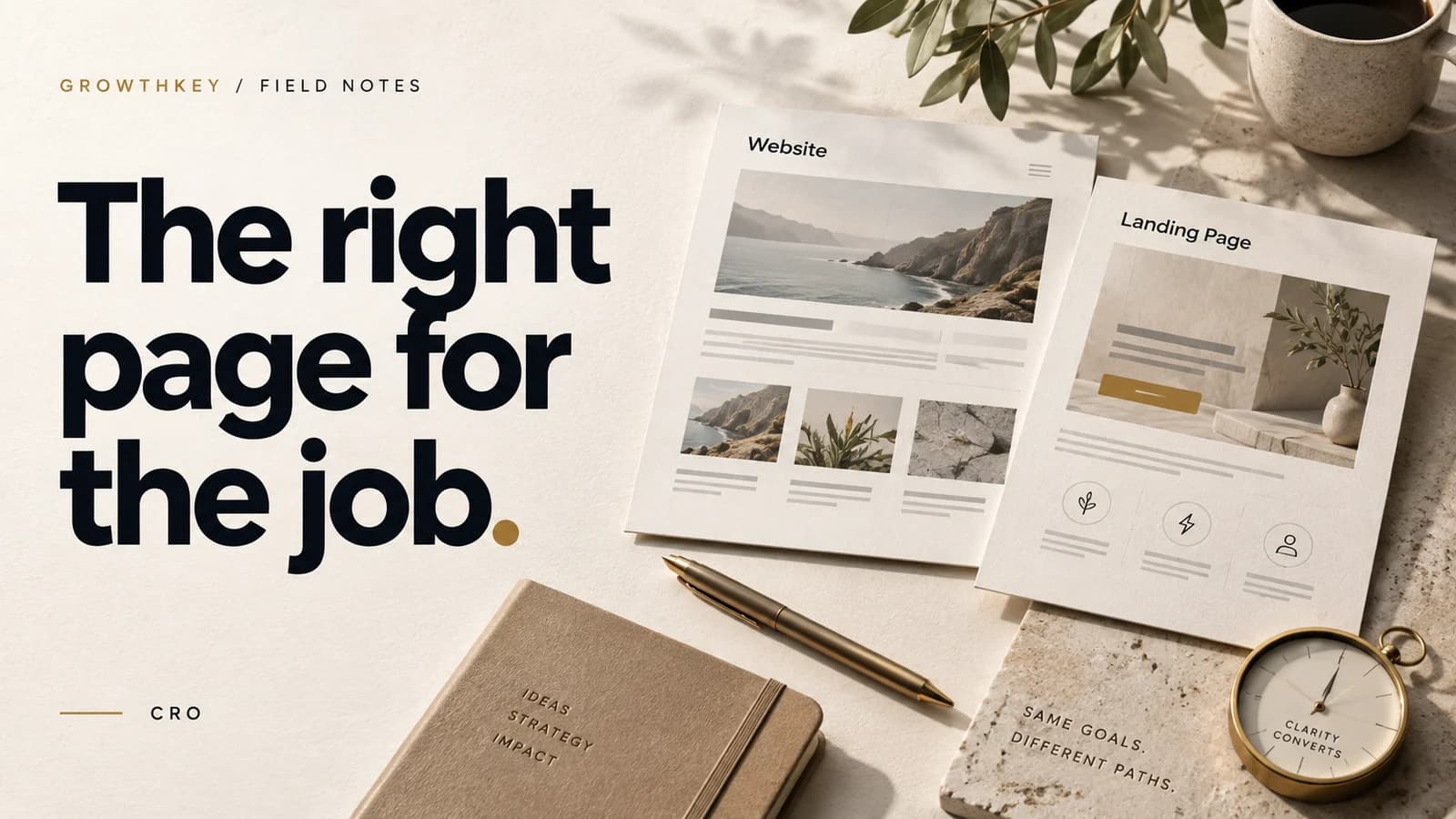
A website serves everyone who arrives — organic searchers, referrals, people checking whether you are real — across many services and many intents. A landing page serves one campaign, one intent, one action. That difference in job produces the difference in results we see over and over: ad traffic on a general homepage converts around 3–6% in our plumbing accounts; the same traffic on a call-first page written to mirror the search runs 12–25%.
Same clicks. Same bids. The page decides whether the math works — which is why "we need a new website" is often an expensive way to buy a conversion rate you could have had in two weeks.
Which problem do you have?
Read down the symptom column; whichever row describes your situation names your fix:
| Symptom | Real problem | Fix |
|---|---|---|
| Ads get clicks; almost nobody calls | No message match — the page answers a different question than the ad | Landing page per intent |
| Organic traffic is fine, ads underperform | The site works for browsers, not buyers | Landing pages; leave the site alone |
| Site is slow, breaks on phones, or looks dated | Credibility and speed — this hurts every channel at once | New website |
| You cannot add or edit pages without a developer | Structural — it will block SEO, AEO, and testing indefinitely | New website |
| You rank for nothing and have no content | Architecture and depth | New website, built for content |
| One service line performs; the rest are invisible | The site treats unequal services equally | Landing pages first, site later |
The order that saves money
When both are genuinely true — a dated site AND no campaign pages — build the landing pages first. They are faster, they prove which messages and offers work, and everything they teach becomes the specification for the rebuild instead of a designer's guess. Rebuilding first means paying for a site designed around assumptions you have not tested yet.
The exception is the credibility floor: if your site is genuinely broken on mobile or takes five seconds to paint, fix that first, because it is taxing every channel simultaneously — ads, organic, referrals, and the customer who Googled you after a recommendation.
What a good campaign page contains
For a service business, the anatomy is short and boring: a headline mirroring the search, tap-to-call above the fold, one primary action, a specific named review within a thumb's reach of the button, three form fields at most, and a page that paints in about two and a half seconds on cellular. Nothing on it is decorative. The teardown checklist covers the full pass, and running it on your current page usually answers this article's question by itself.
If you would rather have someone else run that pass — and tell you honestly which of the two you need — that is the first thing our free audit does.
Frequently asked questions
How much does a landing page cost versus a full website?
A campaign landing page is a fraction of a site build in both money and time — days-to-weeks versus months — because it solves one intent instead of every intent. That asymmetry is the whole argument for testing with pages first: you learn what converts before committing to a rebuild designed around guesses.
Can I just send ads to my homepage?
You can, and the numbers say what it costs: ad traffic on a general homepage converts around 3–6% in our plumbing accounts versus 12–25% on a page built to mirror the search. Same clicks, same spend, roughly three to four times the booked jobs. For low volume it is a survivable compromise; at real spend it is the most expensive shortcut in paid media.
Do landing pages hurt my SEO?
No, when built properly. Campaign pages can be indexed or noindexed depending on purpose, and they live alongside your site rather than replacing content. What hurts SEO is thin duplicate pages spun up per city with no unique substance — a different mistake, and a real one.
How many landing pages do I need?
One per distinct intent you spend real money on — emergency versus scheduled, repair versus replacement, per major service line. Start with your highest-spend intent, prove the lift, then expand. Most service businesses need three to six, not thirty.
What happens after the click?
Let’s review your landing pages, booking flow, and conversion tracking. Get a clear view of what to fix first.
- Your business, your numbers
- Practical next steps
- A conversation with our team
No commitment. Yours to keep.