
Energy Star Builders
Shawn & his team at growth key marketing have done an exceptional job bringing my business up to speed with all of the modern tech & automations.
97% Client Retention Rate
Your buyer already knows their headcount. They need one number to multiply it by, and a menu they can actually read on a phone.The industry gives them “every event is bespoke — contact us for a quote”, and a PDF.So a thirty-second decision becomes a three-day email exchange they only start with two of the five caterers they were considering.
Partner
Meta
Partner
Partner
TikTok
Partner
Partner
Meta
Business Partner
Certified Marketing Partner
TikTok
Marketing Partner
Website design for catering companies is the practice of building a site that lets a buyer with a fixed headcount do the arithmetic themselves — publishing per-head price ranges by service style, presenting menus as real filterable pages rather than a PDF, and answering dietary requirements before they are asked. It is judged on whether a price band exists on the page, whether the menu can be read and filtered on a phone, and whether the enquiry collects date, headcount, venue and service style instead of a name and a message.
Drop-off, buffet, plated, family style, with what changes it. The buyer already knows their headcount — one multiplication is all that stands between them and shortlisting you.
Readable on a phone, filterable by dietary requirement, crawlable by search and quotable by an assistant. The menu is the product and a PDF hides it from everyone.
Vegan, gluten-free, halal, kosher, nut-free. A corporate buyer has to answer this to their own attendees before they can book anything, so a site that cannot is one they cannot use.
The gap
Catering prices per head. The buyer arrives with a headcount already fixed by an invitation list they do not control. One multiplication is the entire gap between browsing and shortlisting — and the industry convention is to withhold the multiplier, on the reasoning that every event is bespoke. Every event is bespoke; the price band is not. Publishing a range by service style costs nothing and removes the only obstacle in the path.
The same instinct produces the menu PDF. It is the product — the single thing the buyer most wants to look at — delivered in a format that is slow on a phone, invisible to search, unquotable by an AI assistant and impossible to filter by dietary requirement. No other trade in this matrix hides its product this thoroughly.
What the delay actually costs
Of mobile visits are abandoned past three seconds to usable — and a menu PDF on a phone is one of the slowest things a small business can serve.
Google / SOASTA, 2017
Conversion lift from a 0.1-second mobile speed improvement, around 10% for lead-generation sites in the same study. Corporate buyers shortlist during a working day, on a phone, at speed.
Deloitte Digital for Google, “Milliseconds Make Millions”, 2020
“Contact us for a quote” is not a way of protecting your pricing. It is a way of being left off a shortlist you were qualified for.
What it's costing you
Most catering enquiries are made by someone doing this as a side task, between other work. Every extra step you add is a reason to stop.
Forty minutes, five caterers, three enquiries
Set by an invitation list and a room booking they did not control. The buyer is not designing an event — they are finding a supplier who fits constraints that already exist.
To multiply by 140 and see whether you are inside the budget line. Four of five catering sites will not give them one, so they cannot tell whether the next twenty minutes are worth spending.
A PDF, on a phone, in a meeting room. Slow, unreadable, and impossible to check for the three dietary requirements they must confirm to their own attendees before booking anything.
To the caterers who published a band and a readable menu. You were qualified, available and affordable — and none of that was ever established, because it could not be established from the site.
You were not rejected. You were skipped, by somebody who could not tell whether it was worth asking.
What your site has to do
Restaurant templates dominate this category and a caterer is not a restaurant — the buyer, the decision and the arithmetic are all different.
Drop-off, buffet, plated, family style — a range each, with what moves it: guest count, staffing, rentals, distance, day of week. A band, not a fixed price, and it commits you to nothing.
The most resisted recommendation on this trade and the one that most reliably increases enquiries. You are not protecting margin by withholding it; you are being skipped by buyers who could not tell whether asking was worth their time.
Menus as web pages, organised by event type and service style, filterable by dietary requirement, readable on a phone without a download, and structured so search engines and AI assistants can read them.
This is usually the largest single improvement in the whole rebuild. The menu is the thing buyers most want to see and the PDF makes it slow for humans and invisible to everything else.
Vegan, vegetarian, gluten-free, halal, kosher, nut-free — what you actually offer, how it is handled, and whether it is a separate menu or accommodated throughout. Filterable, not a footnote.
A corporate buyer has to answer this to their own attendees before they can commit. A caterer whose site cannot answer it is a caterer they cannot use, however good the food is.
Date, headcount, venue, service style, dietary requirements, budget band. Every one of those is already decided when they arrive, and asking for them turns a three-day exchange into a same-day quote.
Speed of response decides a large share of catering work, because the buyer is comparing three quotes and has a deadline. A structured brief is what lets you be first with a real number.
Lead times, how far ahead you book, and honesty about the dates you are already committed on. December and wedding season are largely spoken for months out, and pretending otherwise wastes both sides' time.
It also creates the natural urgency this trade otherwise lacks — a buyer who learns their date is filling books sooner rather than continuing to browse.
The proof
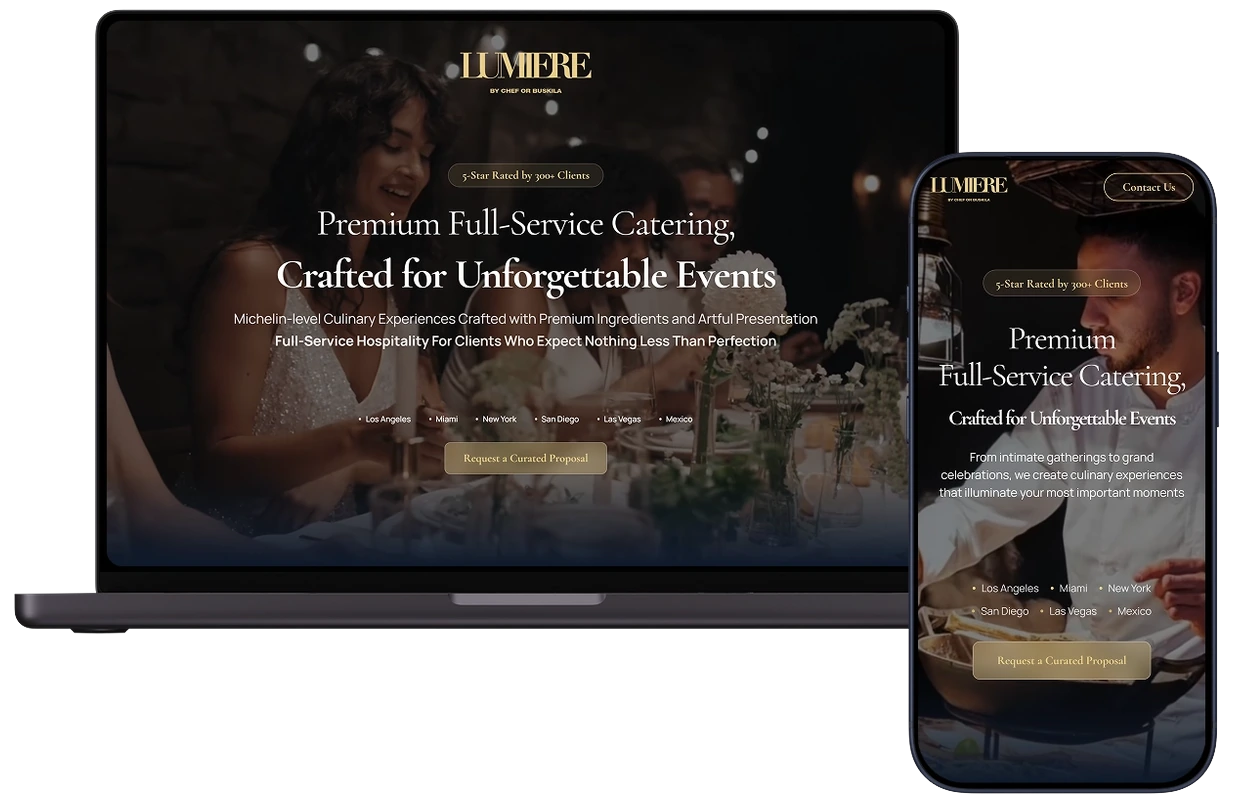
Lumiere Catering
Catering & hospitality · Website + paid social
Lumiere Catering came to us for a website and paid social. No performance figures were published for that engagement, so this card shows the work and what they said about it rather than borrowing numbers from another client.
“Working with Growth Key Marketing has been a fantastic experience! They helped me set up Facebook Ads that actually work. I was blown away by how quickly the ads started bringing in results.”
Our Approach
Most agencies start from a WordPress theme. We build every site from scratch in Next.js — so it loads fast, ranks, and is built around getting you calls.
| Compared on | Custom Growth Key buildHand-built. Tuned for leads. | Typical template sitePre-built. Hard to grow. |
|---|---|---|
| Speed | Custom Growth Key buildFast on a phone — built to pass Google’s Core Web Vitals | Typical template siteSlowed down by heavy themes and plug-ins |
| Design | Custom Growth Key buildDesigned around your offer and your customers | Typical template siteBoxed in by the template’s layout |
| Leads | Custom Growth Key buildCalls, forms and tracking built in from day one | Typical template siteBuilt for easy setup, not for bringing in work |
| Upkeep | Custom Growth Key buildClean code — no plug-ins to patch or break | Typical template siteConstant plug-in updates, conflicts and security fixes |
| Growth | Custom Growth Key buildNew services, locations and pages slot straight in | Typical template siteOne-size-fits-all structure that fights every change |
| Ownership | Custom Growth Key buildYou own the code, the domain and the data | Typical template siteLocked to a theme, a page builder or a platform |
How It Works
Six to eight weeks from kickoff to launch. The order is the point — you cannot design a page before deciding what it has to say, and you cannot improve one you never instrumented.
Before anything gets designed we work out what the site has to say and who it has to say it to — your offer, the objections that lose you jobs, and the words your best customers actually use. Most redesigns fail here, not in the design phase: a beautiful page built on a vague message is just a faster way to lose the lead.
Hierarchy before pixels. We map what a visitor sees first, where the proof sits relative to the ask, how many fields stand between interest and a submitted form, and what the call path looks like on a phone. You approve the skeleton while it is still cheap to change.
Hand-coded on a modern stack — no themes, no plug-in stack to maintain, no page builder deciding what your site can do. Fast by construction rather than by later optimization, and yours outright: the design, the content, and the code, with a handoff any developer can pick up.
Tracking is wired before go-live, not bolted on after — form events, call tracking, and the source that produced each one. Then the site stops being a deliverable and becomes a starting position: we watch what real visitors do and rebuild whatever the data says is lying.
What it costs
Catering arithmetic is unusually easy to run because the product is priced per head and the buyer's headcount is fixed before they arrive.
| What you already spend to fill the site | $1,500–$10,000/mo | Combined paid search, paid social and SEO for a regional catering company, weighted into the corporate and wedding seasons. |
|---|---|---|
| Average corporate event value | $2,000–$15,000 | Per-head pricing across a fixed headcount. Repeat business is the real prize — a corporate client who books once often books quarterly. |
| Average wedding or private event value | $4,000–$30,000 | Longer lead time, more decision-makers, and far more dependent on menu browsing — which is exactly what the PDF is preventing. |
| Conversion rate we usually measure | 0.8%–2% | Enquiries against total sessions. Sites with a menu PDF and no pricing sit at the bottom of that range with unusual consistency. |
| Conversion rate the same traffic supports | 2.5%–4.5% | What a build with published bands and real menu pages reaches on identical traffic. The menu pages alone typically account for most of the gain. |
| Extra events the gap is worth, yearly | 15–60 | From traffic already arriving. Weight it toward corporate, where a single won client can repeat four times a year. |
Conversion ranges are what we observe across catering accounts we audit, not published research. The corporate-to-private mix moves everything here — a wedding-heavy caterer should read the menu row as the decisive one, and a corporate-heavy one should read the dietary and response-speed rows that way.
Why us
We have built and filled a catering company's site before, and the pattern is consistent: the two things buyers need most are the two things caterers publish least.
With the reasoning. It is the most resisted recommendation on this trade and the one that most reliably increases enquiries.
Real pages, filterable by dietary requirement, readable on a phone, crawlable and quotable. Usually the single largest improvement in the rebuild.
For corporate buyers this is close to decisive, because they have to answer it to their attendees before they can book.
Date, headcount, venue, style, budget band — so you quote the same day rather than after three days of email.
Design, content, code, hosting, analytics, and your own food photography at full resolution.
$30M+
In ad spend managed
4.8×
Average ROAS, active accounts
40+
Service businesses scaled
100+
Performance campaigns delivered
The offer
Start with a free website audit. We'll show you where your current site loses people — the pages they leave from, the friction in the form, what it costs on mobile — and what a rebuild would and would not fix. No commitment, yours to keep.
Energy Star Builders
Shawn & his team at growth key marketing have done an exceptional job bringing my business up to speed with all of the modern tech & automations.
Koalaty Remodel
My vision came alive effortlessly. Their blend of casual and professional approach made the process a breeze. Creativity flowed, and the results were beyond my expectations.
Lumiere Catering
Working with Growth Key Marketing has been a fantastic experience! They helped me set up Facebook Ads that actually work. I was blown away by how quickly the ads started bringing i...
Air1 Moving and Storage
It was an absolute pleasure working with them to create a website that truly reflects the quality and professionalism of their moving and storage business. We're thrilled to hear that the new site is making such a big difference! Our goal is always to deliver a seamless experience—both for our clients and their customers—so it's amazing to know that their new website is not only looking great but also helping build credibility and improve functionality. We truly appreciate their trust in GrowthKey, and we're here whenever they need us. Wishing them continued success! 🚀
Space Production
Growth Key Marketing completely transformed our lead generation. Their targeted Facebook campaigns delivered high-quality inquiries almost immediately, and the ROI has been outstanding from day one. Highly recommend their expertise!
NAVA Management
The team at Growth Key took our outdated online presence and turned it into a sleek, high-converting website with smart automations. Leads are coming in consistently now—it's made running the business so much smoother. Truly impressed!
Alluna Dental
We partnered with Growth Key for both website redesign and ongoing digital marketing. The new site looks professional and patient-friendly, while their Facebook ad strategy brought in a steady stream of new appointments. Excellent communication and real results!
CIG Law
Growth Key Marketing nailed our rebranding and online marketing needs. From custom automations that save us hours every week to effective ad campaigns that attract the right clients, they've been a game-changer for our firm. Professional, creative, and dependable.
Move Happy Moving
I can't say enough good things about working with Shawn and the Growth Key team. They built us a modern website that showcases our services perfectly and set up automations for inquiries and follow-ups. Our online bookings have doubled—worth every penny!
FAQ
Straight answers about rebuilding a catering website — pricing, menus, dietary, briefs, and what it will not fix.
A band by service style, with what moves it — not a fixed price. Every event is bespoke; the price band is not. Your buyer has a fixed headcount and needs one multiplication to know whether asking you is worth their time. Withholding it does not protect your margin, it gets you skipped.
Because it is your product, delivered in the least usable format available. A PDF is slow on a phone, unreadable without pinching, invisible to search engines, unquotable by AI assistants, and impossible to filter by dietary requirement. Converting it to real pages is usually the single largest improvement in the rebuild.
For corporate work they are close to decisive. The buyer must answer vegan, gluten-free, halal, kosher and nut-free questions to their own attendees before they can commit. If your site cannot answer them, you are a caterer they cannot use — regardless of how good the food is.
Date, headcount, venue, service style, dietary requirements and a budget band. All of it is already decided before they arrive. Asking turns a three-day email exchange into a same-day quote, and on this trade response speed wins a large share of the work.
In practice it filters rather than loses. A buyer who leaves over a published band was outside your range anyway, and they leave before consuming a tasting or a proposal. What you gain is enquiries from people who already know you are affordable and are now choosing on food.
Partly, and this trade gets more of that effect than most: real menu pages and event-type pages can rank and be cited for searches a PDF was never eligible for. But the main job is converting the buyers who already arrive.
At least address lead times and how far ahead you book. December and wedding season are largely spoken for months out, and saying so creates the urgency this trade otherwise lacks — a buyer who learns their date is filling stops browsing and books.
Six to eight weeks. Converting menus into structured pages is usually the longest task, because it is the first time the menu has existed as data rather than as a document — and that structure is what makes it filterable and quotable afterwards.
It depends on scope — how many menus and event types, filtering requirements, integrations — and we quote after the audit. The number to establish first is how many buyers per season skip you because they could not price you.
Entirely. Design, content, code, hosting and the analytics account, transferable on the day you ask. Your food photography stays yours at full resolution.
Tracking wired before launch, reporting enquiries by event type alongside menu page engagement. On catering the menu pages are usually the strongest predictor of an enquiry, which is a report you cannot run at all while the menu is a PDF.
More for catering companies
A free website audit: what your menu PDF costs you on a phone, how many enquiries the missing price band prevents, whether dietary requirements can be checked at all, and what the gap is worth per season — no commitment, yours to keep.
No pitch deck. Clients average 4.8× ROAS.


