
Energy Star Builders
Shawn & his team at growth key marketing have done an exceptional job bringing my business up to speed with all of the modern tech & automations.
97% Client Retention Rate
The person arriving on your site may be in a hospital bed, on medication, using one hand, on a phone with a cracked screen from the accident.They are not going to read your firm history. They are not going to complete nine fields.And the firm that reaches them first is usually the firm that signs them.
Partner
Meta
Partner
Partner
TikTok
Partner
Partner
Meta
Business Partner
Certified Marketing Partner
TikTok
Marketing Partner
Website design for personal injury law firms is the practice of building the site as an intake system rather than a firm brochure — because the visitor may be injured, medicated or one-handed, the traffic is among the most expensive in local search, and the first firm to make contact very often signs the case. It is judged on how fast a claimant can reach a person, whether each case type has a page written for that specific claimant, and whether the trust it builds uses proof that state bar advertising rules actually permit.
Not time to a form. A one-handed claimant on medication needs a connected call or a two-field message, routed instantly and covered after hours — because the firm that reaches them first usually signs them.
A truck collision, a slip and fall, a dog bite and a wrongful death are four different claimants with four different fears. One 'personal injury' page addresses none of them specifically.
No outcome promises, past results properly disclaimed, testimonials handled within your state bar's requirements. Credibility built from what is allowed and verifiable rather than from what is impressive.
The gap
Personal injury search terms are among the costliest anywhere — a single click on the competitive ones can exceed what a plumber pays for twenty. Then the visitor arrives, injured and one-handed, and is asked to complete a nine-field form that a paralegal will review in the morning. By morning three other firms have called them, and one of them has an appointment.
That is not a marketing problem and it is not a copy problem. It is an intake problem sitting inside a website, and it is the reason two firms buying identical traffic can sign completely different numbers of cases from it.
What the delay actually costs
Of mobile visits are abandoned past three seconds to usable. This claimant is on a phone, possibly one-handed, possibly on hospital wifi.
Google / SOASTA, 2017
Conversion lift from a 0.1-second mobile speed improvement, around 10% for lead-generation sites. On traffic this expensive, tenths of a second have a dollar value you can calculate exactly.
Deloitte Digital for Google, “Milliseconds Make Millions”, 2020
Two firms buy the same clicks at the same price and sign a different number of cases. The difference is almost always intake, and intake starts on the website.
What it's costing you
Personal injury is a race with a very short lead, and most of it is run before anybody in your office knows the claimant exists.
The window is hours, not days
Sometimes from the roadside, sometimes from a waiting room, often by a family member on the claimant's behalf. Whoever is searching is stressed, distracted and using a phone one-handed.
Firm history, attorney biographies and practice-area lists are all irrelevant in this moment. The only questions are whether someone will answer now and whether it costs anything to ask.
Nine fields, on medication, one-handed. A large share never finish — and of those who do, many are then queued until office hours, which in this trade is the same as being lost.
The insurer's adjuster is also calling, often with an offer. A claimant who has heard from nobody else may accept it, and the case is gone before your firm ever knew it existed.
Speed to contact is the single most valuable property of a personal injury website, and it is a build decision rather than a staffing one.
What your site has to do
Law firm templates are built to convey prestige. This site has a different job, and prestige is not on the list.
A persistent tap-to-call, a two-field message option for someone who cannot speak, and instant routing to a human — including after hours, which is when a great deal of this traffic arrives.
A nine-field form reviewed in the morning is not intake, it is a queue. On this trade the queue is where cases are lost, because the claimant is being called by three other firms and an adjuster during it.
Car and truck collisions, motorcycle, slip and fall, dog bite, wrongful death, rideshare. Different claimants, different fears, different questions about liability, timelines and what happens next.
The single 'personal injury' page is the most common structural fault in this category. A claimant searching 'truck accident lawyer' has specific questions about commercial insurance and federal regulations, and a generic page answers none of them.
No outcome promises, past results carrying the disclaimers your state requires, testimonials handled within bar advertising rules, and credentials that are verifiable. Credibility assembled from what is allowed rather than what is impressive.
We build to your state bar's requirements and to your firm's own compliance guidance — we are web developers, not your ethics counsel, and every claim on the page is yours to approve before it ships.
Contingency explained in plain words: what percentage, what happens with costs, what happens if the case is lost, and that the consultation is free. A claimant with no money is not going to ring and ask a law firm whether they can afford it.
One of the highest-value blocks on the page and one of the most commonly buried. Fear of cost stops more contacts than fear of lawyers does.
Call tracking, form events, and time-to-first-contact measured as a metric the firm actually watches. Which case types convert, which pages produce signed cases rather than enquiries, and how long the gap between submission and human contact really is.
That last number is usually the most uncomfortable one in the audit and the most valuable. Firms consistently believe it is minutes and it is consistently hours.
The proof
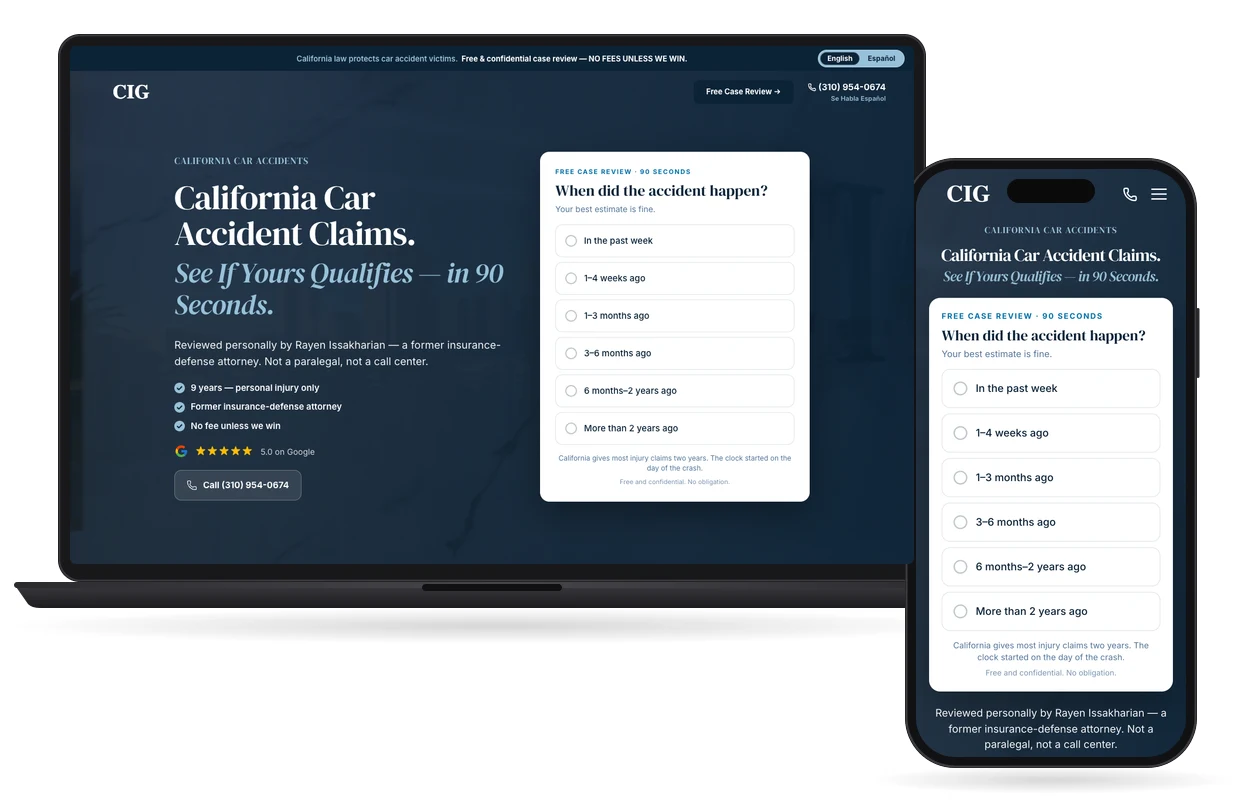
California Injury Group
Personal injury law · Case-intake landing page
California Injury Group runs its car-accident cases through a landing page we built — one question at a time, a named attorney reviewing every claim. No performance figures are published for that engagement, so this card shows what the work was — rather than borrowing numbers from another practice area.
Built a car-accident intake page that qualifies a claim in about 90 seconds — one question at a time, a named attorney reviewing every case, click-to-call for people who won't fill in a form, and a Spanish version.
Our Approach
Most agencies start from a WordPress theme. We build every site from scratch in Next.js — so it loads fast, ranks, and is built around getting you calls.
| Compared on | Custom Growth Key buildHand-built. Tuned for leads. | Typical template sitePre-built. Hard to grow. |
|---|---|---|
| Speed | Custom Growth Key buildFast on a phone — built to pass Google’s Core Web Vitals | Typical template siteSlowed down by heavy themes and plug-ins |
| Design | Custom Growth Key buildDesigned around your offer and your customers | Typical template siteBoxed in by the template’s layout |
| Leads | Custom Growth Key buildCalls, forms and tracking built in from day one | Typical template siteBuilt for easy setup, not for bringing in work |
| Upkeep | Custom Growth Key buildClean code — no plug-ins to patch or break | Typical template siteConstant plug-in updates, conflicts and security fixes |
| Growth | Custom Growth Key buildNew services, locations and pages slot straight in | Typical template siteOne-size-fits-all structure that fights every change |
| Ownership | Custom Growth Key buildYou own the code, the domain and the data | Typical template siteLocked to a theme, a page builder or a platform |
How It Works
Six to eight weeks from kickoff to launch. The order is the point — you cannot design a page before deciding what it has to say, and you cannot improve one you never instrumented.
Before anything gets designed we work out what the site has to say and who it has to say it to — your offer, the objections that lose you jobs, and the words your best customers actually use. Most redesigns fail here, not in the design phase: a beautiful page built on a vague message is just a faster way to lose the lead.
Hierarchy before pixels. We map what a visitor sees first, where the proof sits relative to the ask, how many fields stand between interest and a submitted form, and what the call path looks like on a phone. You approve the skeleton while it is still cheap to change.
Hand-coded on a modern stack — no themes, no plug-in stack to maintain, no page builder deciding what your site can do. Fast by construction rather than by later optimization, and yours outright: the design, the content, and the code, with a handoff any developer can pick up.
Tracking is wired before go-live, not bolted on after — form events, call tracking, and the source that produced each one. Then the site stops being a deliverable and becomes a starting position: we watch what real visitors do and rebuild whatever the data says is lying.
What it costs
On this trade the arithmetic is brutal in a useful way: the traffic is expensive enough that small conversion differences are immediately visible in dollars.
| What you already spend to fill the site | $10,000–$100,000+/mo | Combined paid search, LSA for legal services and SEO. Personal injury is the most expensive traffic in this matrix by a wide margin, which is what makes the conversion rate so consequential. |
|---|---|---|
| Cost per click, competitive terms | $80–$400+ | Which means a visitor lost at field six of a form has a directly calculable price, and it is not a small one. |
| Conversion rate we usually measure | 1.5%–3% | Calls and form submissions against total sessions. Firms with a single generic practice page and a long form sit at the bottom of that range. |
| Conversion rate the same traffic supports | 4%–8% | What an intake-first build with case-type pages reaches on identical traffic. The contact path accounts for more of that gain than the content does. |
| Time from submission to human contact | Minutes, not hours | The number most firms have never measured. It is usually hours, and it is where signed cases are lost to firms that were simply faster. |
| Signed cases the gap is worth, monthly | 2–12 | From traffic already arriving. At personal injury case values, this row generally settles the question of whether a rebuild is worth funding in the first month. |
Conversion ranges are what we observe across personal injury accounts we audit, not published research, and click costs vary enormously by state and case type. Nothing here is a prediction of case outcomes or case value — those depend on facts we know nothing about, and no website changes them.
Why us
We have rebranded and rebuilt for a personal injury firm, and we run the paid channels that fill these sites — so we see what the most expensive traffic in local search actually does when it lands.
One action to contact, routed instantly, covered after hours. Speed to contact is the most valuable property of a PI site and it is a build decision.
Time from submission to human contact. It is usually hours, everyone believes it is minutes, and it explains most of the gap.
Truck, motorcycle, slip and fall, dog bite, wrongful death. Different claimants with different fears — a single practice page addresses none of them.
Built to your state's rules and your compliance guidance, with every claim approved by you before it ships. We do not guess at ethics rules and we will say when something needs your counsel.
Design, content, code, hosting, analytics — unlike the vendor-rented sites that are common in legal and leave when the relationship does.
$30M+
In ad spend managed
4.8×
Average ROAS, active accounts
40+
Service businesses scaled
100+
Performance campaigns delivered
The offer
Start with a free website audit. We'll show you where your current site loses people — the pages they leave from, the friction in the form, what it costs on mobile — and what a rebuild would and would not fix. No commitment, yours to keep.
Energy Star Builders
Shawn & his team at growth key marketing have done an exceptional job bringing my business up to speed with all of the modern tech & automations.
Koalaty Remodel
My vision came alive effortlessly. Their blend of casual and professional approach made the process a breeze. Creativity flowed, and the results were beyond my expectations.
Lumiere Catering
Working with Growth Key Marketing has been a fantastic experience! They helped me set up Facebook Ads that actually work. I was blown away by how quickly the ads started bringing i...
Air1 Moving and Storage
It was an absolute pleasure working with them to create a website that truly reflects the quality and professionalism of their moving and storage business. We're thrilled to hear that the new site is making such a big difference! Our goal is always to deliver a seamless experience—both for our clients and their customers—so it's amazing to know that their new website is not only looking great but also helping build credibility and improve functionality. We truly appreciate their trust in GrowthKey, and we're here whenever they need us. Wishing them continued success! 🚀
Space Production
Growth Key Marketing completely transformed our lead generation. Their targeted Facebook campaigns delivered high-quality inquiries almost immediately, and the ROI has been outstanding from day one. Highly recommend their expertise!
NAVA Management
The team at Growth Key took our outdated online presence and turned it into a sleek, high-converting website with smart automations. Leads are coming in consistently now—it's made running the business so much smoother. Truly impressed!
Alluna Dental
We partnered with Growth Key for both website redesign and ongoing digital marketing. The new site looks professional and patient-friendly, while their Facebook ad strategy brought in a steady stream of new appointments. Excellent communication and real results!
CIG Law
Growth Key Marketing nailed our rebranding and online marketing needs. From custom automations that save us hours every week to effective ad campaigns that attract the right clients, they've been a game-changer for our firm. Professional, creative, and dependable.
Move Happy Moving
I can't say enough good things about working with Shawn and the Growth Key team. They built us a modern website that showcases our services perfectly and set up automations for inquiries and follow-ups. Our online bookings have doubled—worth every penny!
FAQ
Straight answers about rebuilding a personal injury firm's website — intake, case-type pages, bar rules, and what it will not fix.
Because the first firm to reach a claimant very often signs the case, and because the insurer's adjuster is also calling — sometimes with an offer. A form reviewed in the morning is not intake, it is a queue, and the claimant is being contacted by other people during it.
Usually its length and its timing. Nine fields is a lot for someone injured, medicated and one-handed. We replace it with a single-action call path plus a two-field message for people who cannot speak, then route both instantly — including after hours, which is when a great deal of this traffic arrives.
Yes, and the single generic 'personal injury' page is the most common structural fault in this category. Someone searching 'truck accident lawyer' has particular questions about commercial policies and federal regulations; someone searching 'dog bite' has entirely different ones about liability and homeowner's insurance. A generic page answers neither.
As a constraint in the specification, not a review at the end. No outcome promises, past results carrying the disclaimers your state requires, testimonials handled within your rules. We build to your state bar's requirements and your firm's compliance guidance — we are web developers, not your ethics counsel, and every claim ships only with your approval.
Plainly and early. What percentage, what happens with costs, what happens if the case is lost, and that the consultation is free. Fear of cost stops more contacts than fear of lawyers does, and a claimant with no money is not going to phone a law firm to ask whether they can afford one.
Not by itself, though case-type pages can rank for searches a generic practice page was never eligible for. The main job is conversion — and on the most expensive traffic in local search, conversion is where the money is.
Yes. Intake submissions and call events feed the case management system you already run — Filevine, Litify, Clio, MyCase and the common alternatives — so a contact becomes a tracked intake record with a timestamp rather than an email in somebody's inbox.
Six to eight weeks. Compliance review usually sets the pace on the copy, so we build that review into the schedule rather than discovering it in week seven.
It depends on scope — number of case-type pages, intake routing, integrations, locations — and we quote after the audit. The number to establish first is your current time from form submission to human contact, because on this trade that figure usually explains most of the gap.
Entirely. Design, content, code, hosting and the analytics account, transferable on the day you ask. This matters more in legal than most categories, because a large share of firm sites are rented from a legal-marketing vendor and leave when the relationship does.
Tracking wired before launch, reporting contacts by case type and — the important one — time from submission to human contact. Firms consistently believe that number is minutes and it is consistently hours. Measuring it is often the single most valuable output of the engagement.
More for personal injury firms
A free website audit: your real time from submission to human contact, where the intake form loses people, which case types have no page, and what the gap is worth in signed cases — no commitment, yours to keep.
No pitch deck. Clients average 4.8× ROAS.


