ChatGPT Ads / Google Ads
ChatGPT Ads vs. Google Ads for local services
One captures a typed keyword; the other enters a conversation. Where each wins, what transfers, and how to run both on one scoreboard.
In this article
Two different moments, not two versions of one thing
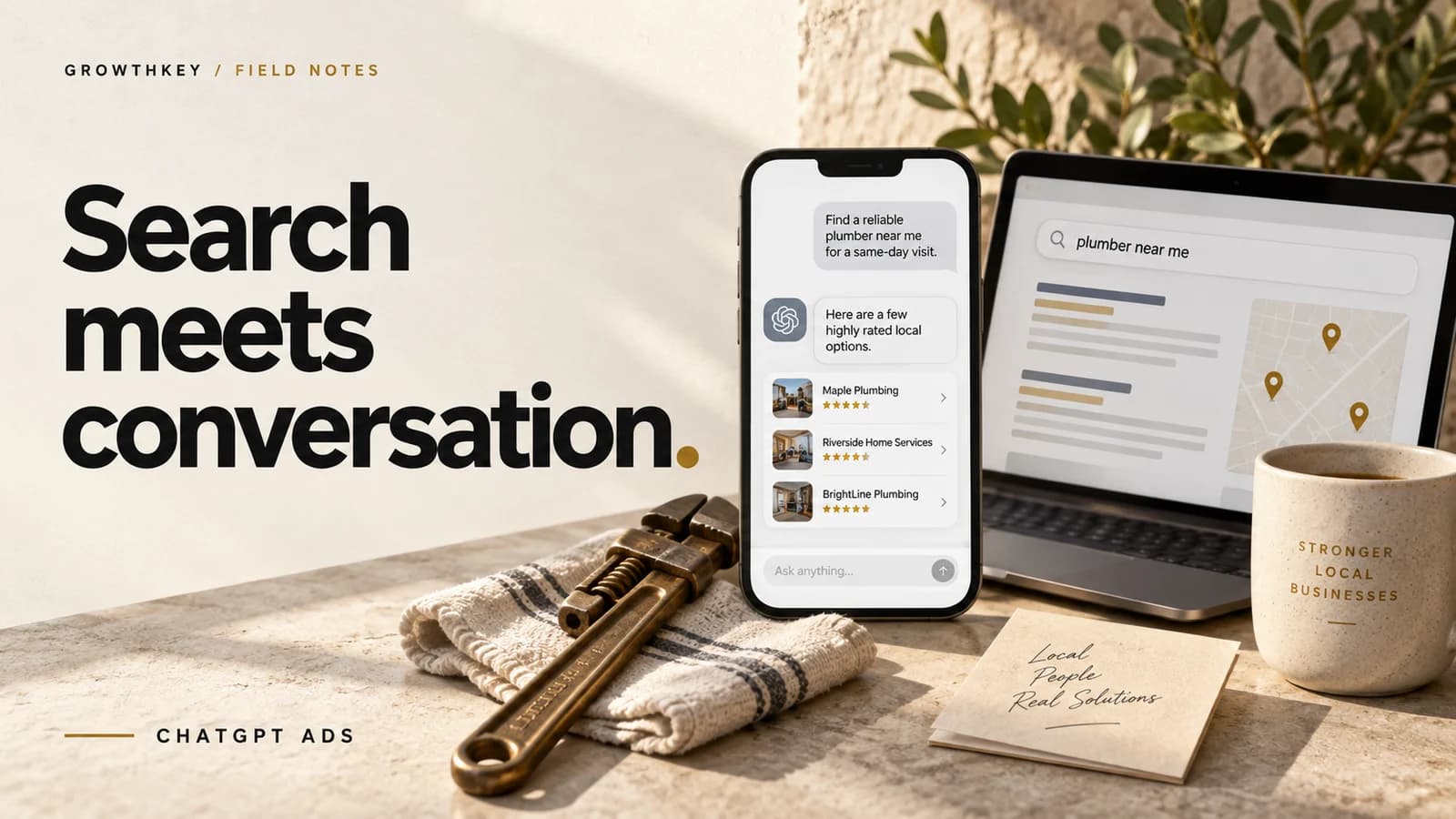
Google Ads captures a keyword: someone typed "emergency plumber near me," and you bid to be the answer. ChatGPT Ads enter a conversation: someone is explaining their whole situation — the leak, the budget, the timeline — and comparing options with an AI, and your ad appears below the answer. Same homeowner, different moment, different job. Most bad takes on this comparison come from treating them as substitutes.
What you control on each
The operator's differences, side by side as of August 2026:
| Google Ads (search) | ChatGPT Ads | |
|---|---|---|
| The moment | A typed query — demand capture | A conversation — decision-shaping |
| Targeting | Keywords, geo, schedule, bids | Creative, landing page, context hints, audiences — no keywords |
| Pricing | Mature auction; trade CPCs from $4 to $250+ | Young auction; $3–5 starting-bid guidance, CPC or CPM |
| Landing page | Conversion surface | Conversion surface AND targeting signal |
| Benchmarks | Two decades of them | None honest yet — you test for your own |
| Best first use | The workhorse for existing demand | A bounded, incremental test |
Where Google still wins, comfortably
Volume and certainty. Google delivers the overwhelming majority of referral clicks on the web, its intent signals are typed in plain text, and its economics are knowable in advance — our observed click costs and budgets by trade exist because twenty years of auctions produced them. For capturing a customer who already knows what they need, search remains the default, and nothing about ChatGPT changes that this year.
Where ChatGPT is genuinely interesting
Context and timing. The conversation carries information a keyword never could — constraints, comparisons, hesitations — and the ad arrives while the decision is still forming rather than after it is made. Auctions are young, which sometimes means underpriced attention. And it pairs with the organic side: the same conversations where your ad can appear are the ones AEO work gets you named inside. Presence twice on one screen is a position Google search cannot offer.
How to run both without fooling yourself
Additive, never substitutive: keep Google's proven campaigns fully funded, stand up a governed ChatGPT test on incremental budget, and grade both on one scoreboard — qualified cost per lead through to booked jobs. After 60–90 days one of two things is true: the new channel earns a permanent line in the budget, or you retire it with evidence. Both outcomes beat the third option most businesses choose, which is wondering.
Frequently asked questions
Should I move budget from Google Ads to ChatGPT Ads?
No. Fund a ChatGPT test incrementally and leave proven Google campaigns alone — defunding a channel that books jobs to try one without benchmarks is how experiments turn into revenue dips. Additive testing, one scoreboard, then let qualified cost per lead reallocate the budget.
Which is cheaper — ChatGPT Ads or Google Ads?
Unknowable in general, and the honest comparison is not clicks anyway. Google's service-business CPCs range from $4 to $250+ by trade against known conversion rates; ChatGPT's young auctions start around $3–5 bids with no reliable conversion data yet. The only meaningful answer is your own test's qualified cost per lead against your own Google baseline.
Do ChatGPT Ads and Google Ads reach the same people?
Often the same people at different moments — researching in a conversation versus acting on a typed search. That is precisely why they stack: the conversation shapes the shortlist, the search executes it, and businesses present at both moments compound their odds.
Where does Meta fit in this comparison?
A third moment again: Meta interrupts people who were not looking, which builds the memory that later becomes the search or the question. Our cold/warm/hot system covers that playbook — the three platforms are a sequence, not rivals.
Are your leads becoming customers?
Let’s review your campaigns, tracking, and the steps between a click and a customer. Get a clear view of what to fix first.
- Your business, your numbers
- Practical next steps
- A conversation with our team
No commitment. Yours to keep.