Meta Ads / Home Services
Facebook ads for home services: the cold / warm / hot system
Nobody scrolls Instagram looking for a plumber — and that's fine. Meta ads work when each audience stage gets its own message.
In this article
The objection that's half right
"My customers aren't scrolling Facebook for a plumber." Correct — nobody searches social media the way they search Google. But your customers are absolutely there, and interruption is a different weapon than intent: Meta is where a homeowner meets you before the emergency, so that when the water heater bursts, yours is the name they remember or the ad that follows them.
The businesses that make Meta pay treat it as a system of three audiences, each with its own job, message, and budget. The ones that "boost posts" and quit in a month treated three jobs as one.
Cold, warm, hot — each stage gets its own campaign
The structure is simple to describe and decisive in practice:
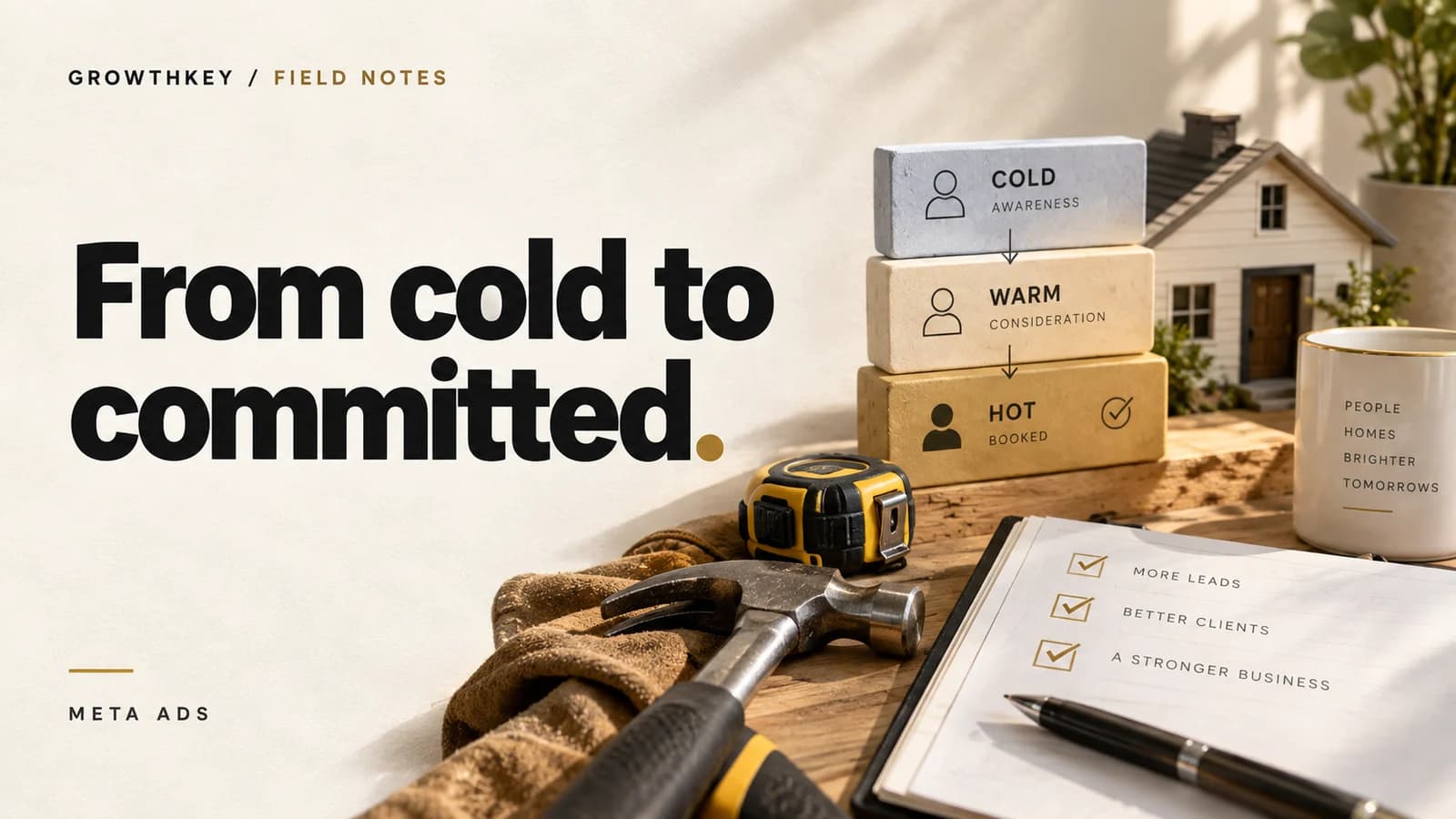
- Cold (strangers): the job is attention and memory, not the sale. Real crews, real jobsites, a hook in the first two seconds, and one idea per ad. Lookalikes of past customers and broad local targeting both work — the creative does the targeting now.
- Warm (met you once): video viewers, page engagers, site visitors. The job is belief: reviews, before/afters, "here's exactly what happens when you call." This is where proof lives.
- Hot (leads who didn't book): quotes that stalled, forms that never scheduled. The job is the nudge — the offer, the deadline, the click-to-call. Small audience, outsized return; most accounts we audit don't have this campaign at all.
Creative anatomy, stage by stage
The message ladder only works if the creative actually changes per stage. What we ship at each:
- Cold creative: native-looking phone footage beats polish — a real tech at a real jobsite, the problem visible in the first two seconds, one plain-language idea ("your water heater is 12 years old — here's what that means"). Educational hooks outperform CALL NOW at this stage because the audience is problem-aware at best.
- Warm creative: proof artifacts — a review read aloud, a before/after pair, a 30-second walkthrough of what a service call actually looks like. Specificity is the conversion lever: "fixed our slab leak same day" is a warm ad script by itself.
- Hot creative: plain offer mechanics — the discount with a real deadline, the "your quote is still good" reminder, click-to-call as the only button. Short, un-clever, and shameless about asking.
What changed under the hood: Advantage+ and CAPI
Two platform shifts define running Meta in 2026. Advantage+ campaign structures have absorbed most of the manual levers — audience settings collapse toward broad, and the creative carries the targeting, which makes the per-stage creative discipline above MORE valuable, not less. Run Advantage+ as the default with guardrails (geography, exclusion of existing customers where it matters) and split stages by campaign so budgets stay deliberate.
And measurement moved server-side: with browser signals decaying, the Conversions API is how Meta actually learns what a booked customer looks like — feed it real outcomes (booked, quoted, completed) rather than form fills, or the optimizer chases the wrong crowd. The pixel alone is no longer enough plumbing.
Budget and measurement
A starting split we use often: roughly 60% cold, 25% warm, 15% hot — rebalanced monthly by cost per booked job, which is how one contractor client ended up doubling down on Meta when the data said so. What the levels buy: around $1,500/month runs a credible two-stage system in one metro; $3,000 funds all three stages with creative testing; $6,000+ is where lookalike expansion and aggressive cold testing earn their keep. Below $1,000, run warm and hot only — retargeting the traffic your other channels already bought is Meta's cheapest win.
And grade the system honestly: engagement doesn't pay the bills, so we don't optimize for it. Booked calls and cost per job, tracked from click to invoice — likes are a side effect, never the goal.
When Meta is wrong for your trade
Honesty section: some accounts shouldn't be here yet. Pure-emergency, low-ticket work with no recurring layer (a $150 one-off service) rarely supports interruption advertising — there is no "before the emergency" moment worth buying. Businesses at capacity should fix pricing or hiring first. And a Meta system with no follow-up spine — no CRM, no fast callback, no call tracking — leaks its leads before the invoice: this channel produces interested humans, and interested humans go cold in hours. If any of those describe you, spend the money on search intent or the trust floor instead, and come back when the funnel can catch what Meta throws.
Frequently asked questions
Do Facebook ads actually work for home services?
Yes — as a memory-and-demand system, not a search engine. Nobody searches Instagram for a plumber, but homeowners meet you there before the emergency, and retargeting catches the ones who almost booked. Graded on cost per booked job with real outcome tracking, Meta regularly earns 15–40% of a service-business media budget in our accounts.
Should I use Advantage+ or manual campaigns?
Advantage+ as the default in 2026 — the platform has absorbed most manual levers anyway — with guardrails: tight geography, sensible exclusions, and stages split by campaign so cold, warm, and hot keep deliberate budgets. Fight the machine on creative quality and conversion data, not on audience micromanagement.
What budget should a service business start with on Meta?
Under $1,000 a month: run warm and hot only — retargeting is the cheapest win. Around $1,500: a two-stage system in one metro. At $3,000: all three stages with creative testing. Scale past that only when cost per booked job has held for a month — the split is roughly 60/25/15 cold/warm/hot, rebalanced by results.
Should I run Meta before or after Google Ads?
Usually after — capture existing demand first, because it converts sooner and funds everything else. The exception is trades with real elective or seasonal demand, where Meta's job of creating the pipeline starts earlier. Either way the two compound: Meta builds the memory, search catches the moment.
Are your leads becoming customers?
Let’s review your campaigns, tracking, and the steps between a click and a customer. Get a clear view of what to fix first.
- Your business, your numbers
- Practical next steps
- A conversation with our team
No commitment. Yours to keep.