Google Ads / Med Spa Marketing / Campaign Structure
MedSpa PPC structure: when treatments need separate campaigns
Decide when MedSpa treatments need separate campaigns, budgets and pages. Includes an account map, routing checks and launch checklist.
In this article
- Structure the account around treatment and operating decisions
- Write a treatment-control sheet before creating campaigns
- Group searches by the decision the page can answer
- Separate brand demand from new-patient acquisition reporting
- Make the initial account map small enough to operate
- Control search overlap with a query-routing review
- Keep the page and booking route inside the same plan
- Review goals and automation before expanding the account
- Use a launch checklist and a consolidation rule
- Make complexity earn its place
- Frequently asked questions
Structure the account around treatment and operating decisions
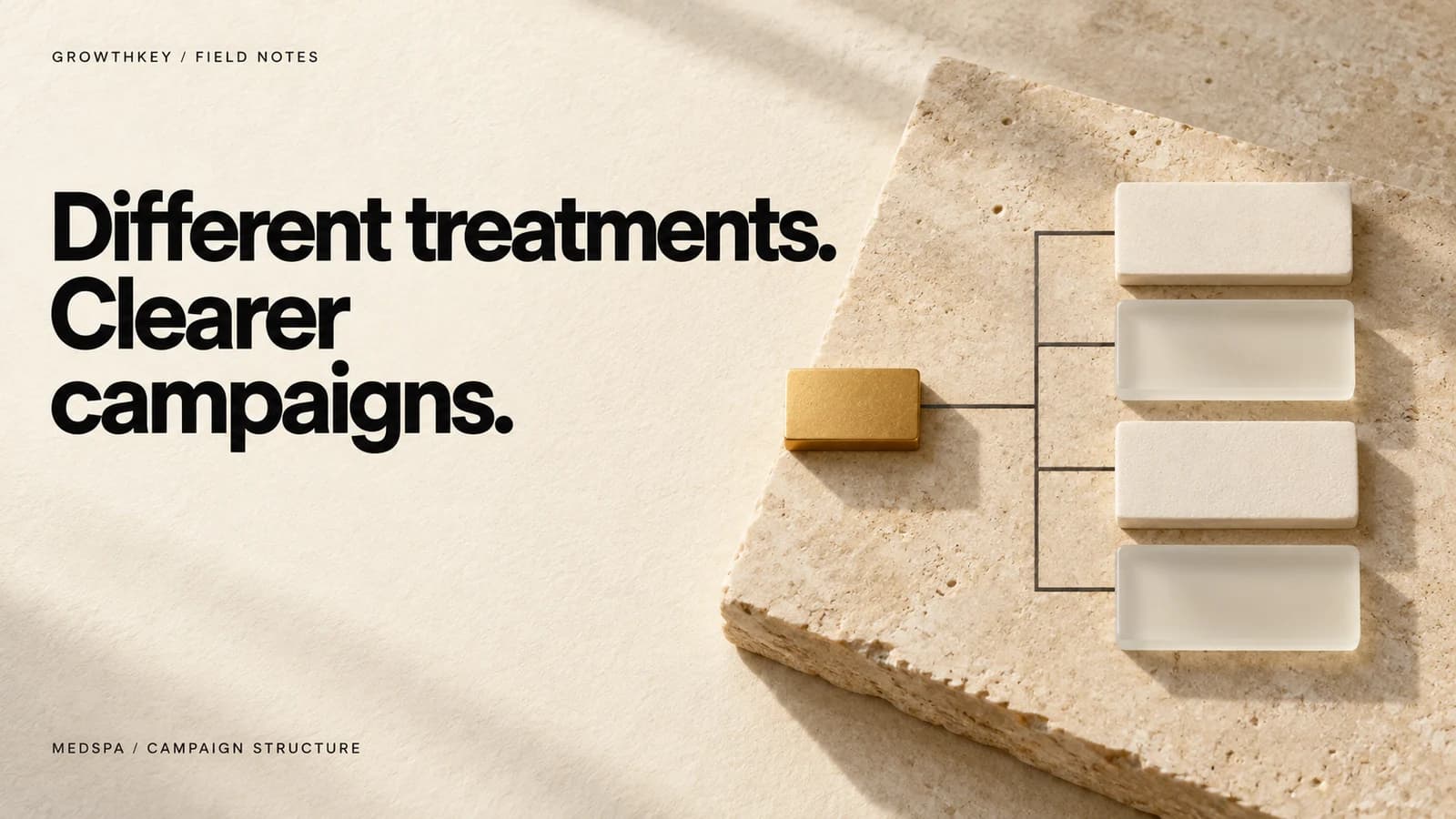
MedSpa PPC campaigns should separate treatment groups when their budget, economics, provider capacity, location or schedule needs independent control. Ad groups should then connect a coherent search intent with an accurate ad and an appropriate page. A campaign for every menu item is not automatically better than a carefully organized shared campaign.
The distinction matters because an injectable consultation, a device-based service and a broad skin-treatment enquiry can use different resources and produce different timelines. A blended conversion total can hide which one is consuming the budget and whether its enquiries become appropriate, attended appointments.
This walkthrough uses an illustrative U.S. clinic and contains no client account data or clinical recommendations. Start with the Google Ads for MedSpas guide for the complete process, and use the MedSpa budget model to decide how much scope the test can support.
Write a treatment-control sheet before creating campaigns
For every proposed treatment group, record the service actually offered, the provider and location, the appointment route, current capacity, delivery economics and any advertising-policy conditions. Ask the clinic who can change the availability or approve a new promise. That list identifies the controls the account must preserve.
Then distinguish a message difference from a business-control difference. Two searches may need different pages while sharing the same budget and appointment process. Conversely, two similar treatments may need separate campaigns if one has constrained provider availability or a protected launch allocation.
| Difference between services | Likely design response | What to verify |
|---|---|---|
| Different budget owner or protected allocation | Separate campaigns with explicit budget ownership | Whether a shared budget would defeat the intended protection |
| Different locations or staffed schedules | Separate campaign delivery controls | The provider, phone route and actual appointment calendar |
| Different intent, same operating constraints | Distinct ad groups and relevant pages | Whether one coherent ad can answer each group |
| Different treatment economics | Separate reporting; campaigns when bids or budgets need independent control | Contribution, capacity and the chosen outcome |
| Different product or policy eligibility | A documented eligibility decision before launch | The actual service, country, advertiser, creative and destination |
Group searches by the decision the page can answer
Do not make an ad group a container for every service that shares a body area or a fashionable label. The useful unit is a visitor decision. A general consultation search, a named treatment search and a product-purchase search may share words while requiring entirely different answers.
A treatment ad group should have a clear destination and next step. If the available page cannot accurately answer the group, build or revise the page before expanding the keywords. If the clinic does not offer the requested service, adding a vague consultation button does not make the traffic appropriate.
Injectable services need a policy decision and an assessment path
Use the exact service information supplied by the clinic. Product-brand terms such as Botox or Dysport require review under the current healthcare and medicines rules, including applicable restricted-term requirements. A generic synonym is not an exemption. Separate the marketing enquiry from the clinician's determination of treatment suitability or quantity.
Device treatments need service and capacity specificity
A page about laser hair removal should not quietly stand in for every laser or skin service. Confirm what the clinic provides and what equipment and provider time the booking consumes. Different pages may be appropriate even when the services share a budget. Split campaigns when a constrained device schedule or materially different economics requires separate control.
Comparison searches may belong to a consultation page
Someone weighing treatment approaches may need a provider-led assessment rather than a product-specific booking. Give that intent its own useful explanation. Do not answer clinical suitability questions in ad copy merely to increase the conversion rate; let the qualified provider make the recommendation.
Separate brand demand from new-patient acquisition reporting
Keep the clinic's name, provider navigation and non-brand treatment discovery visible as different sources of demand. A returning patient searching for the phone number can generate a profitable booking without representing new-patient acquisition. Label that outcome accurately rather than excluding it from the business report altogether.
For a new-location campaign, distinguish the new office's demand from an established office's name recognition. A convenient combined report can conceal that one location receives most of the enquiries or that prospects are reaching the wrong calendar.
Use the clinic's approved records to classify new and returning patients. Do not assume that patient lists can be uploaded to create exclusions or audiences. The health-related personalized advertising policy restricts advertiser-curated audiences for sensitive services, including injections. Campaign structure does not remove those restrictions.
Make the initial account map small enough to operate
The example below assumes one location, verified service availability and enough budget to evaluate more than one treatment objective. A clinic with less capacity or evidence should begin with fewer acquisition rows. This is a design example, not a recommendation to activate every listed service.
Name campaigns for location, channel and purpose. Give each page and appointment route an owner. Keep the outcome column in the practice's business report; it is not an instruction to upload treatment records to Google Ads.
| Campaign | Ad groups | Destination and route | Business outcome / owner |
|---|---|---|---|
| Main clinic / Search / Brand | Clinic and provider navigation | Location or provider page; correct office calendar | New and returning bookings reported separately / clinic manager |
| Main clinic / Search / Consultations | Eligible injectable consultation intents with distinct messages | Reviewed service-specific consultation pages | Attendance and appropriate completed treatment / provider and consultation coordinator |
| Main clinic / Search / Laser hair removal | Closely related local service enquiries | Verified service page and assessment route | New treated patients and equipment capacity / scheduling owner |
| Main clinic / Search / Skin consultation | Relevant comparison and consultation intents | Scoped assessment page | Appropriate attended consultations / provider team |
When to combine treatment groups
If two groups share location, schedule, budget ownership, outcome definition and acceptable acquisition economics, a shared campaign can be reasonable. Preserve distinct ad groups and pages. Explain what evidence would justify splitting them later, such as one group consuming spend while another needs a protected test.
When to split them
Separate campaigns when a real constraint demands it: a provider has limited consultation sessions, a location needs a different area, a service needs independent budget approval, or the outcome economics require a different bidding decision. The split should make an operating choice possible, not simply add rows to a report.
Control search overlap with a query-routing review
Review examples of the searches each group is meant to serve, the page they should reach and the searches that should be excluded. Google's keyword matching documentation explains why match types can cover meanings beyond literal wording. A tidy keyword spreadsheet is not the same as a verified traffic pattern.
Consider training, jobs, wholesale supplies, equipment purchases and services not offered as candidate exclusions. Confirm the full query first. A practitioner searching for a course differs from a prospective patient asking what a consultation involves; the exclusion needs to match that difference.
Do not blanket-exclude price, financing or comparison language. Those questions can indicate a person who needs clearer information. Judge the theme against qualified enquiries and the subsequent consultation process before assuming the word itself is the problem.
Check the scope of every shared list. Google's negative-keyword guidance notes that close variants are not automatically covered. Cross-campaign exclusions should have a destination that remains eligible and available; otherwise the intended routing may simply suppress relevant traffic.
Keep the page and booking route inside the same plan
Create a route inventory that lists the ad group, final URL, location, next step and responsible staff member. Test the route on a phone. Confirm whether the action requests contact, books a consultation or books a service that the clinic has approved for direct scheduling.
Make provider identity, pricing basis and any stated deposit or cancellation terms clear. If a person is comparing services, avoid forcing them to select a treatment they have not been assessed for. A well-structured campaign cannot compensate for a booking form that assumes a clinical decision has already been made.
When a clinic changes its menu, provider availability or booking software, review the route inventory before leaving campaigns on autopilot. A valid URL can still be the wrong destination. The MedSpa website design framework describes the trust and information work those pages need to support.
Review goals and automation before expanding the account
For each campaign, record the approved conversion action used for optimization and the separate business outcome used for evaluation. Check the actual conversion-goal configuration. A common failure is to make forms, button clicks and page engagement look like equivalent wins while the clinic judges success by attended consultations.
Keep patient-level records, treatment interests and revenue detail in approved practice workflows. Google's customer data policies restrict sensitive conversion information. Do not treat a new CRM integration or an encrypted field as permission for an otherwise prohibited upload.
If adding standard Performance Max, remember that asset groups organize assets around a theme; they do not each provide an independently protected campaign budget. Review Performance Max's structure before recreating the Search map as a set of asset groups and expecting the same controls.
Inspect URL expansion, brand handling and eligible audience settings. An automated campaign should not silently send a treatment enquiry to a general article or count existing demand as the acquisition lift the test was supposed to investigate.
Use a launch checklist and a consolidation rule
Before launch, ask someone who did not build the account to follow the intended enquiry routes with synthetic test data. Confirm the advertised service, page, schedule, office and handoff. Keep tests out of real patient reporting and do not submit sensitive information through advertising tools.
During the initial review period, look for redundant groups, mismatched destinations and campaigns too thin to support a useful decision. Consolidate when the operating constraints align and the extra division no longer earns its complexity. Do not change every major variable at the same time if you want to understand the result.
- Service and policy: The clinic offers the treatment; the provider, product, country, audience and claims have been reviewed.
- Budget and delivery: Each campaign has a clear purpose, authorized spend, appropriate location settings and a serviceable schedule.
- Message and destination: Keywords, ad text and the landing page describe the same decision and next step.
- Booking and ownership: The correct office receives the enquiry, the coordinator knows the promised next step and backup coverage is defined.
- Measurement: Approved events are tested once, duplicates are controlled, and clinic-side cohort reporting has clear definitions.
- Review: The team knows who can pause a broken route, correct an inaccurate promise or approve a budget change.
Make complexity earn its place
The account should help the clinic decide which demand to buy and which process to improve. If a split does not protect a real constraint or make a useful comparison possible, question it. If a combined campaign hides incompatible economics or capacity, separate it deliberately.
For help turning that map into a working acquisition program, explore Google Ads management for MedSpas. Start with the service menu, capacity sheet, aggregate funnel report and current account structure. Together, they show more than a list of treatment keywords.
Frequently asked questions
Does every MedSpa treatment need its own Google Ads campaign?
No. Split campaigns for independent budgets, schedules, geography, capacity or economic targets. Distinct ad groups and destination pages can preserve relevance when those operating constraints are shared.
Should injectable and laser services share a campaign?
Only if their operating and economic requirements align and each intent still has appropriate creative and pages. Service availability, provider or equipment constraints and advertising eligibility can justify separate control.
Can we use a brand campaign to identify existing patients?
A brand campaign identifies a type of search demand, not a patient's history. Classify new and returning patients inside approved clinic systems, and do not assume patient lists may be uploaded to advertising platforms.
Can a small MedSpa budget support several treatment campaigns?
Sometimes, but the test needs enough activity and elapsed time to answer its question. If the scope is too broad, choose fewer treatment objectives while retaining relevant ad groups and pages.
Do Performance Max asset groups have separate budgets?
They do not each provide an independently protected campaign budget. If separate spending control is essential, design the campaign architecture accordingly rather than assuming an asset-group label enforces it.
How often should campaign structure change?
Change it when operating conditions or evidence justify a different control, not on an arbitrary schedule. Review after service launches, provider or location changes and meaningful shifts in demand. Record the reason and avoid several simultaneous changes that make the outcome hard to interpret.
Sources & further reading
Are your leads becoming customers?
Let’s review your campaigns, tracking, and the steps between a click and a customer. Get a clear view of what to fix first.
- Your business, your numbers
- Practical next steps
- A conversation with our team
No commitment. Yours to keep.