Ad Copy / Marketing Psychology
What makes great ad copy? The buyer psychology behind ads that convert
Great ad copy is aligned, not clever. What research on emotion, loss aversion and choice says about how buyers decide — and how to write ads that meet them there.
In this article
- Feel first, justify second
- The three questions an ad answers before anyone reads it
- Lever one: write to what the buyer already knows
- Lever two: anchor to a desire the buyer already has
- Lever three: pull one documented trigger
- The mechanics underneath: five findings that change how a line reads
- Where the line is
- The platform shapes the sentence
- Four rewrites, with the lever named
- How you know it worked
- Frequently asked questions
Feel first, justify second
A feed ad gets a moment, not a meeting. In that moment the buyer is not weighing your credentials; they are deciding — mostly below the level of words — whether this thing is for them. The credentials matter, but they matter second, and copy that gets the order wrong reads like a résumé shouted at a stranger.
The best evidence for this comes from the largest set of measured campaigns anyone has assembled. When Hamish Pringle and Peter Field analysed the IPA dataBANK for Brand Immortality — around 1,400 effectiveness cases — campaigns built on emotional content reported very large profit gains roughly twice as often as campaigns built on rational content alone: 31% versus 16%. Campaigns that mixed the two landed in between.
That is not an argument for dropping the facts. It is an argument about sequence. A homeowner reading a plumbing ad at 6 a.m. with no hot water feels relief at the word "today" — and then checks whether you are licensed, what it costs, and what other people said. Emotion selects; reason ratifies. Great ad copy gives the feeling first and the reasons directly under it, and never asks the reader to do those two jobs in the wrong order.
The three questions an ad answers before anyone reads it
Most advice on "ad copy psychology" is a list of triggers — scarcity, social proof, urgency — and it fails for the same reason a list of spices is not a recipe. A trigger only works when the reader is at the right point to be triggered by it. So before a single line is written, every concept we ship is labelled with three things: the awareness stage it targets, the desire it anchors to, and the one influence principle it pulls. That is the whole framework behind our ad copywriting service, and it is what this article walks through: the three levers, the mechanics underneath them, where the line is, and how to tell whether any of it worked.
Lever one: write to what the buyer already knows
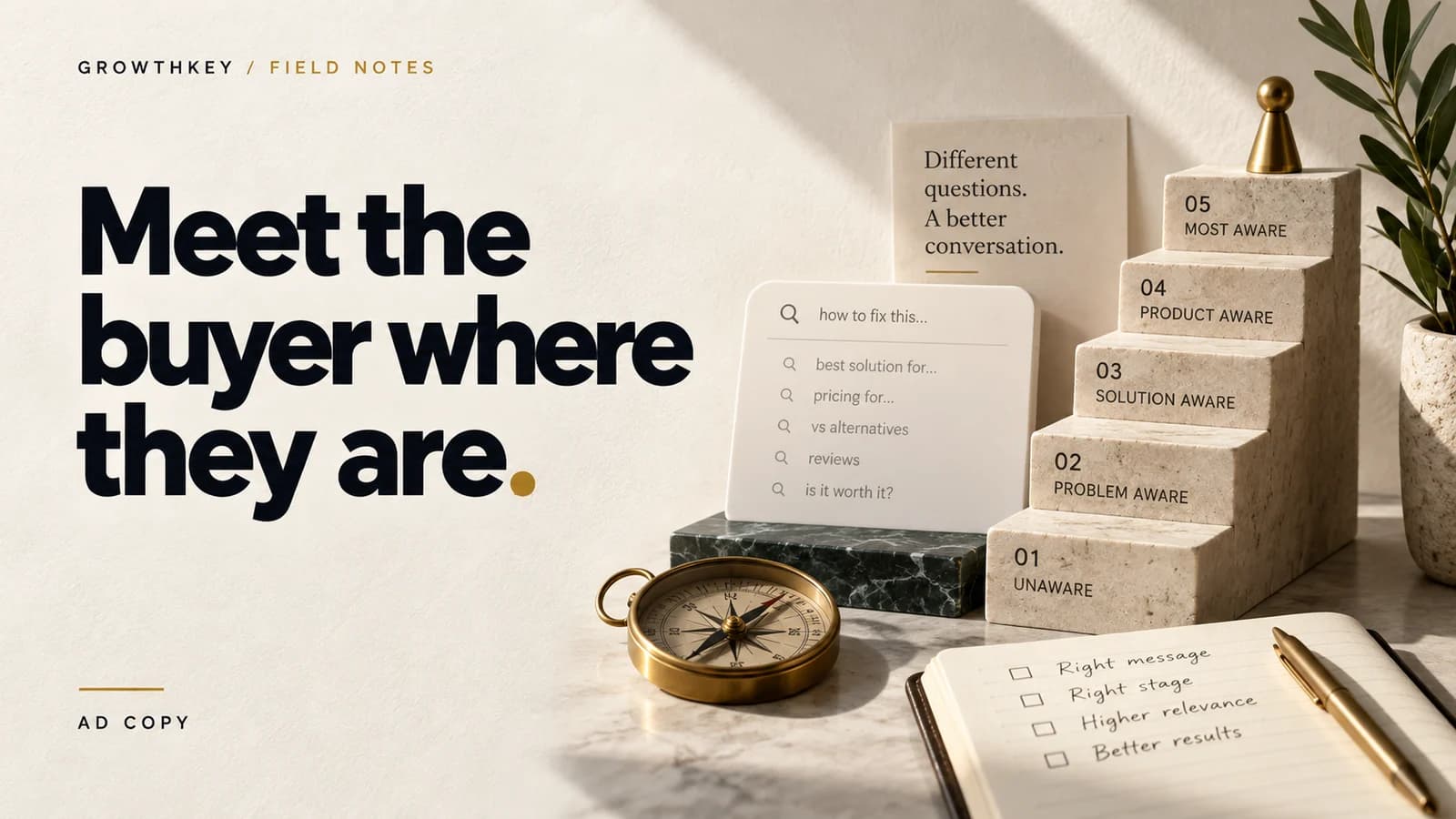
Eugene Schwartz’s five levels of awareness — unaware, problem-aware, solution-aware, product-aware, most aware — are the most useful thing ever written about copy, and we have a full walkthrough of the ladder for anyone who has not met it. The point that matters here is narrower: awareness dictates the opening line, and the traffic source tells you the awareness level before you write a word.
Search traffic declares itself. "No hot water" is problem-aware; "water heater replacement cost" is solution-aware; "your company name reviews" is product-aware. Social traffic is almost always unaware or problem-aware — nobody opens Instagram to hire a roofer. Retargeting audiences are product-aware by definition; they have met you. The same plumber therefore needs three different first lines, not one line in three placements:
- Problem-aware (a feed ad): "No hot water this morning? There are three usual causes, and one of them is a five-minute fix." The ad sells the diagnosis, not the plumber.
- Solution-aware (a search ad): "Water heater replaced today — flat quote before we start, ten-year tank warranty." The searcher already wants a replacement; the ad answers price, speed, and risk.
- Product-aware (retargeting): "Still deciding? Here is the quote sheet we showed you, and the two line items other plumbers leave off it." The reader has seen you; the ad handles the comparison they are already making.
Lever two: anchor to a desire the buyer already has
Nobody wants a furnace. They want a warm house and to stop thinking about the furnace. Nobody wants a personal-injury lawyer; they want the bills to stop arriving and the insurer to take them seriously. Nobody wants "injectables"; they want to look rested at the reunion. Ads that sell the thing instead of the want are describing the delivery truck, not the delivery.
In Cashvertising, Drew Eric Whitman collapsed the wants people reliably pay to satisfy into eight — survival and enjoyment of life, food and drink, freedom from fear and pain, companionship, comfortable living, being better off than the neighbours, protection of loved ones, and social approval. Two more are implicit in most service trades: saving time and avoiding embarrassment. You do not need to agree with the list to use the discipline: every ad should be traceable to one of them, and most service ads are not.
The failure mode is feature copy. "NATE-certified, family-owned, 24/7, financing available" is a list of proofs with the reason missing. Proof belongs in the ad — it does the ratifying job from the first section — but it belongs after the desire, not instead of it. A simple test: take each feature and keep adding "so that…" until you arrive at one of the eight. "Same-day service, so that the house is cool tonight, so that the kids sleep, so that you stop worrying." The last clause is the headline. The feature is the second line.
Lever three: pull one documented trigger
Robert Cialdini’s principles of influence — reciprocity, commitment and consistency, social proof, authority, liking, scarcity, and (added later) unity — are the part of the toolkit everyone has heard of and most ads misuse by using all of them at once. An ad carrying four triggers reads like a ransom note. One trigger per concept, and test the triggers against each other rather than stacking them. In a service ad, each looks like this:
- Social proof: a real count in a real place — "four hundred five-star reviews in Pasadena" — beats "highly rated". The number and the town are what make it proof. Fake counts are illegal now; more on that below.
- Authority: a licence number, years in the trade, a named manufacturer certification. Credentials the reader could check outperform adjectives the reader cannot.
- Scarcity: "two installation slots left this week" — only if it is true. Scarcity in a service business is usually calendar scarcity, and calendars are real.
- Reciprocity: give something first. A free inspection, a free written estimate, a guide to the three questions to ask any contractor. The give must be unconditional or it reads as bait.
- Commitment: ask for the small yes before the big one. "Book a twenty-minute inspection" is easier to say yes to than "replace your roof", and a person who said yes once is more likely to say it again.
- Liking and unity: a face, a first name, the owner on camera; "we live in the Valley too". For a trade that sends a stranger into someone’s house, being a known person is not soft — it is the conversion.
The mechanics underneath: five findings that change how a line reads
The three levers decide what the ad says. These decide how it lands. Each is a replicated finding with a primary source, and each has a direct consequence for a thirty-character headline.
| Finding | What the research showed | What it means for the line |
|---|---|---|
| Loss aversion — Kahneman & Tversky, 1979 | Losses weigh roughly twice as heavily as equivalent gains in how people decide. | "Don’t lose another weekend to a leaking roof" outpulls "enjoy a dry home". Name the cost of waiting, not only the benefit of acting. |
| Choice overload — Iyengar & Lepper, 2000 | Shoppers offered six jams bought far more often than shoppers offered twenty-four — about 30% versus 3% of those who stopped at the table. | One offer and one action per ad. "Repairs, installs, maintenance, financing" is a menu, and menus do not convert. |
| Processing fluency — Song & Schwarz, 2008 | The same instructions set in a hard-to-read font were judged to take longer and to be less worth doing. | Short words, plain syntax, one idea per line. If a line is hard to read, the job feels hard to buy. |
| Specificity | Concrete, checkable detail is read as more credible than round or vague claims — Ogilvy’s 1958 Rolls-Royce headline about the electric clock is the canonical case. | "Most repairs finished in under four hours" beats "fast service". "$89 diagnostic, credited to the repair" beats "affordable". |
| The power of free — Ariely, Predictably Irrational | A price of zero produces a response out of proportion to the saving. Free is a category, not a discount. | A free inspection, estimate, or guide is the strongest reciprocity move a service business has — provided "free" has no asterisk. |
Where the line is
Everything above can be faked, and the faked versions are why "psychological triggers" has a bad name. Countdown timers that reset on reload. "Only two left" on a service with no capacity limit. Reviews written by the owner’s cousin. Testimonials from customers who do not exist.
There are two reasons not to, and the ethical one is not the only one. The legal ground moved: the FTC’s Consumer Reviews and Testimonials Rule took effect on October 21, 2024, and fake reviews, bought reviews, and suppressing negative ones are now civil-penalty territory rather than grey area — we covered what that means for a service business. Google’s own misrepresentation policy disapproves ads with claims the advertiser cannot substantiate, and a disapproval cascade can take an account down with it.
The economic reason is simpler. For a service business, the ad’s job is a booked job, not a click. A trigger that wins the click from someone who then feels handled does not convert on the phone — and you paid for the click. The rule we run every concept through: every claim in the ad must be true, and provable by the person who answers the call.
The platform shapes the sentence
Psychology sets what the ad has to say; the placement sets the container, and the two constraints have to be written together.
On Google Search, responsive search ads take up to fifteen headlines of thirty characters and four descriptions of ninety, and Google assembles up to three headlines and two descriptions per impression. The consequence most accounts miss: no headline can depend on another for its meaning, because you do not control which ones appear together. Every headline has to stand alone, and the searcher told you their awareness level in the query — answer it in the first headline, not the third.
On Meta and TikTok the buyer is unaware or problem-aware and did not ask for anything. The creative earns the stop — that is a different craft — and the first line of primary text earns the read, because the feed truncates the rest behind "See more". The first sentence is the ad; everything after the fold is for the person who is already interested. The cold-to-warm structure that governs which message goes to which audience is its own article.
And wherever the click lands, the promise in the ad has to reappear in the page’s headline. A visitor who clicked "flat quote before we start" and arrives at a page that says "Welcome to our website" has been asked to start over, and most will not. Message match is the first of five landing-page levers for a reason.
Four rewrites, with the lever named
These are illustrative rewrites, not client results, and every claim in the second column has to be true for the business that would run it. What they show is the pattern: the "before" is a most-aware ad aimed at everyone; the "after" picks a stage, a desire, and one trigger.
| Before | After | What changed |
|---|---|---|
| "Family-owned HVAC company. Sales, service & installation. Call today!" | "AC out in a heatwave? Same-day repair across the Valley — flat diagnostic, quoted before we touch anything." | Problem-aware traffic hears its problem first; the desire is comfort and the end of worry; the trigger is a small, specific commitment. |
| "Injured? We fight for you. Free consultation. No fee unless we win." | "The insurer already has a lawyer. You have been talking to them without one. A twenty-minute call — no cost, no obligation." | Loss aversion: what the reader is giving up right now. Reciprocity in the call. The three phrases every firm uses are gone. |
| "Botox, fillers, laser & more. Book your appointment now!" | "Look rested at the reunion — not different. Natural-result injectables, planned weeks ahead in a free consult." | Anchored to social approval and a specific moment; "not different" answers the fear that stops most first-timers; the menu is removed. |
| "Licensed, insured, affordable movers. Get a quote!" | "One crew, one truck, one written price — Pasadena to Austin, and no surprise on delivery day." | Specificity (the route is named), loss aversion at the delivery-day fear, and one offer instead of three adjectives. |
How you know it worked
Click-through rate is not the judge. A headline that wins curious clicks from the wrong people raises CTR and worsens the only number that matters, which is cost per booked job. Grade copy on the call, not the click — which means call tracking has to be in place before the test starts, or the test cannot be read.
Change one lever at a time. Hold the stage and the desire, swap the trigger; or hold the trigger and swap the desire. Because every concept is labelled with all three, a winning variant tells you why it won, and the next round starts from the why instead of from a blank page. Across the accounts we run, the pattern is consistent: a measurable movement in cost per acquisition inside the first thirty days of a new copy round, and compounding gains around day sixty, once two rounds of test data have been decoded.
If you would rather read the results than write the rounds, this is exactly what our ad copy and content writing service does: three to five concept boards per campaign, each labelled with the awareness stage it targets, the desire it anchors to, and the trigger it pulls, then tested against your real cost per booked job. It starts with a free thirty-minute audit of the copy you are running now — including the parts that are already working, which we will not touch.
Frequently asked questions
What makes ad copy effective?
Alignment, not cleverness. Effective ad copy matches the reader’s awareness stage (what they already know about their problem and your solution), anchors to a desire they already have rather than a feature you want to sell, and pulls one documented influence principle rather than several at once. Then it states the proof — price, speed, credentials, reviews — directly under the feeling, so the reader can justify the decision they have already half made.
Is emotional or rational ad copy more effective?
Emotional, by the largest measured dataset available: in Pringle and Field’s analysis of the IPA effectiveness cases, campaigns built on emotional content reported very large profit gains about twice as often as rational ones (31% versus 16%). But the finding is about sequence, not exclusion. The feeling earns attention; the facts close the sale. A service ad needs both, in that order.
Which psychological triggers work best in ads?
It depends on the reader’s awareness stage, which is why trigger lists on their own underperform. For service businesses, social proof with a real number and a real place, and specificity (a checkable price, time, or credential) are the safest performers because they are simply true. Scarcity works when it is real calendar scarcity and backfires when it is invented. Reciprocity — a free inspection or estimate with no strings — is usually the strongest single move for a local trade.
How long should ad copy be?
As long as the awareness stage needs and the placement allows. Google responsive search ads cap headlines at thirty characters, so each one has to carry a complete idea. In a social feed the first sentence of primary text is effectively the whole ad, because everything after it hides behind "See more". Longer copy earns its length only when the reader is unaware of the problem or the ticket is high — personal injury, a full HVAC replacement — and needs to be walked from the symptom to the decision.
Is it legal to use urgency and scarcity in ads?
Yes, when they are true. A real deadline, a real number of open appointments, or a genuine price change are all fair. Fabricated countdowns, invented stock counts, and fake or filtered reviews are not: the FTC’s Consumer Reviews and Testimonials Rule (effective October 21, 2024) makes fake and suppressed reviews civil-penalty offences, and Google’s misrepresentation policy disapproves ads with claims the advertiser cannot substantiate.
How do you test ad copy?
One lever at a time, judged on cost per booked job rather than click-through rate. Label every variant with the awareness stage, desire, and trigger it uses; change only one of the three between variants; make sure call tracking is in place before the test starts; and give each round enough spend to produce real conversions rather than clicks. When a variant wins, the label tells you why, and the next round builds on that reason.
Sources & further reading
Are your leads becoming customers?
Let’s review your campaigns, tracking, and the steps between a click and a customer. Get a clear view of what to fix first.
- Your business, your numbers
- Practical next steps
- A conversation with our team
No commitment. Yours to keep.