

Energy Star Builders
Shawn & his team at growth key marketing have done an exceptional job bringing my business up to speed with all of the modern tech & automations.
97% Client Retention Rate
Somebody with toothache is searching right now, and Google should win that.But the patient who has been quietly unhappy about their teeth for eleven years has never searched for anything — and they are the implant case, the aligner case, the full-arch case.That demand does not exist until something creates it.
Partner
Meta
Partner
Partner
TikTok
Partner
Partner
Meta
Business Partner
Certified Marketing Partner
TikTok
Marketing Partner
Meta Ads for dental practices is paid Facebook and Instagram advertising aimed at elective treatment — implants, clear aligners, veneers and full-arch — rather than at routine new-patient demand, which is searched and belongs to Google. Elective dentistry is discretionary, visual, financed and decided over weeks by patients who have been unhappy about their teeth for years without ever searching, which makes it demand creation rather than capture. It is also a category where Meta's personal-attributes policy constrains the copy, because implying knowledge of someone's health is prohibited.
Cleanings and toothaches are searched. Implants and aligners are wanted for years before anybody searches, which is the gap a feed fills.
A five-figure case is a monthly payment question. Patients who cannot see an affordable figure disqualify themselves silently and never appear in a report.
Meta prohibits ads that assert or imply personal attributes, and health is on that list. The second-person question dental advertisers reach for by instinct is the prohibited construction.
As a certified Meta Business Partner, we bring verified strategies and craft campaigns that don’t just run — they scale.



Why Meta here
A patient missing teeth, or unhappy enough with their smile to consider veneers, has almost always felt that way for years. They have not searched, because searching means admitting the decision is live and finding out what it costs. That is not a demand-capture problem — there is no demand to capture yet — and it is the reason dental practices with excellent Google Ads still have empty elective diaries.
A feed reaches that person in the only way they can be reached: incidentally, without them having to raise their hand first, next to a real result from someone in a similar position. And because the ad can carry a financed monthly figure, it answers the question that was actually stopping them — which was never whether the treatment exists.
Why the feed reaches the elective patient
The feed decides who they call before they ever search.
How the decision actually happens
This is the elective patient's actual timeline, and every stage of it is invisible to a search campaign.
Years of avoidance, then about six weeks of decision
They do not smile in photographs, they chew on one side, they have stopped mentioning it. There is no query for this, no budget line and no enquiry — and no search campaign in the world reaches them.
A real patient, a real result, a practice nearby. This is the moment the private thing becomes a possible thing, and it happens in a feed or it does not happen.
And most practices will not say. Without a payment figure the patient assumes a number far above the real one — five-figure treatments are routinely imagined at twice their actual monthly cost — and quietly stops.
With the practice that showed a result and named a monthly figure. Very often that practice appears in reports as a branded search, and search takes the credit for a decision the feed created.
Nothing about this sequence produces a search until it is nearly over. That is the whole argument for this channel on this trade.
What we'd actually run
Creative is the lever the algorithm has not absorbed. On this trade it also has to clear a policy that most dental advertisers discover the hard way.
A real case, well lit, with the patient's story in their own words where they are willing. This is the most persuasive object available to a dental practice and it is permitted — before-and-after transformation is allowed for cosmetic work under Meta's standards.
Consent and record-keeping are yours and your counsel's, and we build to whatever your practice's policy is. What we will not do is substitute stock imagery, which underperforms real cases by a wide margin in every dental account we run.
Elective dentistry is a financing decision. Patients routinely imagine a five-figure treatment at roughly twice its real monthly cost, and then stop — silently, without ever contacting anybody.
Naming a from-figure early converts more consultations than any other single change we make to a dental account, and it improves consultation quality at the same time, because the patient arriving already knows the range.
Every headline written as a statement about what the practice offers rather than a question about the reader. It is what the policy requires, and it happens to be the better ad — it sounds like a practice rather than an infomercial.
We review the full slate against Meta's standards before launch. A rejection costs a week of learning phase, which on a channel that needs conversion volume to optimise is more expensive than it looks.
What the implant process actually involves, whether it hurts, how long it takes, what the alternatives are. Elective dentistry is postponed out of fear as much as cost, and the clinician answering plainly is the fastest route past it.
One filming session produces a month of distinct ads, which is the real defence against the creative fatigue that kills these accounts.
Anyone who visited an implant or aligner page, opened a financing calculator, or started a booking and stopped. They are mid-decision by definition, and this is the cheapest booked case on the account.
Budgeted separately from prospecting, always — blending them produces a flattering average that hides whether new patient creation is working at all.
Cleanings, check-ups and emergency appointments are searched. A feed campaign chasing them competes badly against Google Ads and Local SEO for demand that already exists and is already looking.
We would rather move that budget to your search account than run a Meta campaign we expect to lose. Elective is where this channel earns.
Before you write a single ad
Dental is one of the categories Meta's advertising standards genuinely constrain, and the constraint is grammatical rather than strategic — which means it is cheap to fix and expensive to discover in a rejection. Each step below cites Meta's own published standards.
The rule is stated plainly: ads must not contain content that asserts or implies personal attributes, and advertisers must not imply that they are aware of someone's personal attributes or those of their family. The covered list includes physical or mental health, including medical conditions.
Meta Transparency Center — Privacy Violations and Personal AttributesMeta publishes “Do you have diabetes?” as non-compliant. “Missing teeth?”, “Embarrassed by your smile?” and “Suffering with dentures?” are the same construction — a second-person question that implies the advertiser knows something about the reader's health.
Meta Transparency Center — Privacy Violations and Personal AttributesMeta publishes “Bulimia counseling available” as compliant. The difference is person and voice: a third-person statement about a service you offer, rather than a second-person question about a condition you are presuming. “Dental implants available in [city] — from $X/month” clears the rule and says more.
Meta Transparency Center — Privacy Violations and Personal AttributesContrary to what most dental advertisers believe, Meta's standards permit general cosmetic products, procedures and surgeries depicting before-and-after transformation, subject to an 18+ targeting requirement — and dental products are named as exempt from that age requirement. What is prohibited is different: statements of inferiority about physical appearance, and exaggerated or extreme claims and promises of specific outcomes.
Meta Transparency Center — Health and WellnessSo you can show the result. You cannot tell the reader what you think is wrong with them — and the fix is usually one sentence rewritten from a question into a statement.
Full-Service Management
Meta Ads isn’t one job — it’s four that have to agree with each other. Targeting decides who sees the ad, creative decides whether they stop, strategy decides what it costs, and tracking decides whether any of it can improve.
Custom — past callers & quotes
2,400Lookalike 1% — LA homeowners
412KInterest — HVAC · owns home
188KWe build audiences from your own data first — past customers, quote requests, site visitors — then mirror them with lookalikes. Interest stacks are the fallback, never the plan.
Your water heater is 12 years old. It knows it, too. Flat-rate replacement, installed tomorrow.
Ads written for the person mid-scroll, not the ad platform. Every angle ships as competing variants; the losers are killed weekly and the winner's budget grows.
Leads — Water Heaters Q3
ActiveAd set · Prospecting
$55/dayAd set · Retargeting 30d
$25/dayProspecting fills the funnel, retargeting closes it — with budgets split deliberately between the two so you're never paying cold-traffic prices for warm leads.
Conversions API
ConnectedLead — form submit
2 min agoSchedule — booked call
26 min agoPurchase — $1,890 job
1 hr agoPixel plus Conversions API, wired to the events that matter: leads, booked calls, closed jobs. Meta optimizes toward whatever you feed it — we make sure that's revenue.
The proof
Alluna Dental came to us for a website redesign and ongoing Facebook advertising — the two halves of this page. The figures below are theirs, published, and they are why this cell argues from a result rather than a theory.
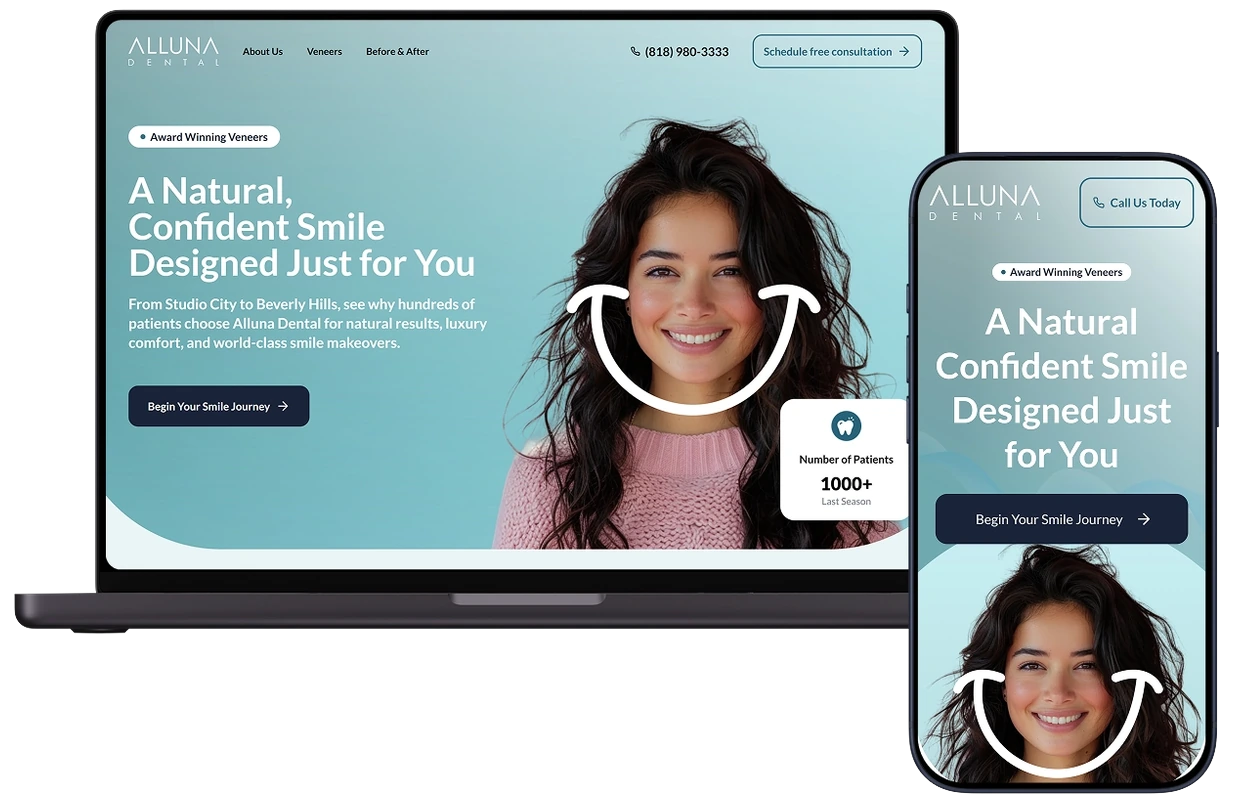
Alluna Dental
Dental practice · Website redesign + paid social
Rebuilt the landing page with insurance-match messaging, a shorter appointment form, and patient reviews above the fold. Tested three calls to action to turn more visits into bookings.
Conversion rate
Cost per lead
Monthly bookings
What it costs
Our observed ranges. The elective rows are the reason this channel is funded at all on this trade.
| Cost per lead, elective consultations | $45–$150 | Implants, aligners, veneers and full-arch. Higher than routine leads and worth many times more. |
|---|---|---|
| Consultation-to-case-accepted rate | 20%–40% | Depends more on your treatment coordinator than on the ad. Practices that name a financing figure in the creative sit at the top of that range, because the patient arrives pre-qualified. |
| Average elective case value | $4,000–$50,000 | Full-arch sits at the top. One accepted case frequently covers a quarter of spend, which is what makes the softer close rate survivable. |
| Cost per accepted elective case | $400–$1,600 | The only figure worth comparing against your other channels. Against a four- to five-figure case this is one of the strongest ratios in the matrix. |
| Cost per lead, routine new patient | $25–$70 | Cheaper, and mostly the wrong target here — that demand is searched, and search wins it. Shown so the comparison is honest rather than flattering. |
| New patient lifetime value | $1,500–$5,000 | Which is why routine acquisition is still worth funding — on Google Ads and Local SEO, where the patient went looking first. |
These are our observed ranges across dental accounts, not published research; payer mix, region and how much elective work the practice does move all of them substantially. Alluna Dental's figures shown on this page are that client's own published results, not a general claim about what a practice should expect.
Why us
We have run exactly this for a dental practice — website and paid social together — and the figures are published rather than described.
Alluna Dental: website redesign plus Facebook advertising, and a published +218% conversion rate, 61% lower cost per lead and 3.4x monthly bookings.
Third-person construction by default, the full slate reviewed against Meta's standards before launch. A rejection costs a week of learning phase, which is more expensive than it looks.
Patients imagine elective treatment at roughly twice its real monthly cost and stop silently. Naming a from-figure is the single highest-return change on a dental account.
Routine new-patient demand is searched and belongs to your Google Ads and Local SEO. We would rather move that budget than run a campaign we expect to lose.
The dentist answering what patients are afraid of, shot by our videography team. One session, a month of distinct ads, and no fatigue cliff.
$30M+
In ad spend managed
4.8×
Average ROAS, active accounts
40+
Service businesses scaled
100+
Performance campaigns delivered
The offer
Start with a free Meta Ads audit. We'll show you your competitors' live ads from Meta's own public Ad Library, what your account is actually paying per booked job rather than per lead, and an honest read on whether this is your best next dollar. No commitment, yours to keep.
Energy Star Builders
Shawn & his team at growth key marketing have done an exceptional job bringing my business up to speed with all of the modern tech & automations.
Koalaty Remodel
My vision came alive effortlessly. Their blend of casual and professional approach made the process a breeze. Creativity flowed, and the results were beyond my expectations.
Lumiere Catering
Working with Growth Key Marketing has been a fantastic experience! They helped me set up Facebook Ads that actually work. I was blown away by how quickly the ads started bringing i...
Air1 Moving and Storage
It was an absolute pleasure working with them to create a website that truly reflects the quality and professionalism of their moving and storage business. We're thrilled to hear that the new site is making such a big difference! Our goal is always to deliver a seamless experience—both for our clients and their customers—so it's amazing to know that their new website is not only looking great but also helping build credibility and improve functionality. We truly appreciate their trust in GrowthKey, and we're here whenever they need us. Wishing them continued success! 🚀
Space Production
Growth Key Marketing completely transformed our lead generation. Their targeted Facebook campaigns delivered high-quality inquiries almost immediately, and the ROI has been outstanding from day one. Highly recommend their expertise!
NAVA Management
The team at Growth Key took our outdated online presence and turned it into a sleek, high-converting website with smart automations. Leads are coming in consistently now—it's made running the business so much smoother. Truly impressed!
Alluna Dental
We partnered with Growth Key for both website redesign and ongoing digital marketing. The new site looks professional and patient-friendly, while their Facebook ad strategy brought in a steady stream of new appointments. Excellent communication and real results!
CIG Law
Growth Key Marketing nailed our rebranding and online marketing needs. From custom automations that save us hours every week to effective ad campaigns that attract the right clients, they've been a game-changer for our firm. Professional, creative, and dependable.
Move Happy Moving
I can't say enough good things about working with Shawn and the Growth Key team. They built us a modern website that showcases our services perfectly and set up automations for inquiries and follow-ups. Our online bookings have doubled—worth every penny!
FAQ
Straight answers on budgets, timelines, retargeting, and how results are actually tracked.
For elective treatment, very well — implants, aligners, veneers and full-arch are discretionary decisions made over weeks by patients who have been unhappy for years and never searched. For routine new patients they work poorly, because that demand is searched and Google Ads and Local SEO should win it. Practices with excellent search and empty elective diaries are the clearest case for this channel.
No, and this is the most common dental ad rejection. Meta prohibits ads that assert or imply personal attributes, and physical health including medical conditions is on that list — their own published non-compliant example is “Do you have diabetes?”, which is the identical construction. The fix is grammatical: “Dental implants available in [city] — from $X/month” says more and clears the rule.
Yes — this is the misconception that costs practices the most. Meta's standards permit cosmetic procedures depicting before-and-after transformation subject to an 18+ targeting requirement, and dental products are specifically named as exempt from that age requirement. What is prohibited is different: statements of inferiority about physical appearance, and exaggerated claims or promises of specific outcomes.
They should usually lead with it. Elective dentistry is a monthly payment decision, and patients routinely imagine a five-figure treatment at about twice its real monthly cost before quietly stopping. Naming a from-figure converts more consultations than any other single change we make, and it improves consultation quality because the patient arrives already knowing the range.
Real patient results with consent, and the dentist on camera answering what patients are actually afraid of — whether it hurts, how long it takes, what the alternatives are. Elective treatment is postponed out of fear as much as cost. Stock imagery underperforms both by a wide margin.
We build to your practice's policy and your counsel's guidance — consent and record-keeping for patient imagery are yours, and we will not improvise them. On the advertising side we configure pixels and events deliberately for a health context rather than accumulating them, which is a distinction most dental accounts have never had made for them.
Softer, yes — 20–40% of elective consultations to an accepted case, and that depends more on your treatment coordinator than on the ad. But a single accepted case runs $4,000–$50,000, so cost per accepted case lands at $400–$1,600, which is one of the strongest ratios in our whole matrix.
Generally $2,500–$8,000 a month for a single-location practice running elective campaigns. Below roughly $1,500 the algorithm never gets enough conversion data to optimise, and the account stays expensive for reasons that look like the channel's fault rather than the budget's.
Consultations inside two to four weeks; accepted cases on a longer lag, because the elective decision runs about six weeks and financing approval sits inside it. A full quarter is the fair test, and the leading indicator to watch in the meantime is consultation quality rather than volume.
More for dental practices
Start Here
A free Meta Ads audit: your competitors' live dental ads from Meta's public Ad Library, a policy review of your current copy against Meta's personal-attributes standard, and what your account pays per accepted case rather than per lead — no commitment, yours to keep.


