



Energy Star Builders
Shawn & his team at growth key marketing have done an exceptional job bringing my business up to speed with all of the modern tech & automations.
Built around patient decisions
An insurer your patient never chose has already decided which practices they will consider. Your only move is to be unmistakably inside that list at the moment they look.
Partner
Meta
Partner
Partner
TikTok
Partner
Partner
Meta
Business Partner
Certified Marketing Partner
TikTok
Marketing Partner
Google Ads for dental practices is paid search built around three intents — emergency toothache searches that convert within minutes, insurance-network queries where patients filter by who takes their plan, and high-value procedure research for implants, Invisalign and veneers — measured on the lifetime value of a new patient rather than the fee for a first exam.
Why it matters
An urgent problem can compress the decision into a short search for a practice that can help. Other patients research insurance, providers or elective treatment over a much longer period. The campaign and landing page should respect both journeys.
One Sunday night, and a family's dentist for a decade
It has been sensitive for a fortnight and easy to ignore. Tonight it is not ignorable, it is Sunday, and the practice they have not been to in three years is closed until Tuesday.
“Emergency dentist near me,” then, almost immediately, whether anyone open tomorrow takes their insurance. Two questions, one search session, and the practice that answers both on the same screen wins.
Not the best reviewed. The one displaying an actual opening tomorrow morning and a plainly stated in-network list. A contact form promising a callback within one business day loses to a visible 8:40 AM slot every time.
A first appointment may be followed by recurring care or household referrals. Track those outcomes over time and count only the value the practice actually observes.
That is why cost per new patient is the wrong number on its own — the emergency visit is the introduction, and everything the practice earns for the next ten years traces back to who was bookable on a Sunday night.
The auction
A new patient can represent more than one appointment: recurring care, accepted treatment and household referrals may add value over time. That value needs to be measured in the practice’s own cohorts rather than assumed for every patient.
Patient-value analysis can support a different acquisition budget from a first-exam calculation. The decision still depends on margin, capacity, retention evidence and cash flow; a larger bid is not automatically a better one.
Stats that prove it
The most valuable search in dentistry is not “best dentist.” It is the name of an insurance plan followed by three words — and it is sitting there uncontested.
Certified & integrated with





 Microsoft Clarity
The campaign mix
Acute pain, an insurance change, a specific procedure and a general search are four different people with four different urgencies. The generic term is the one everybody bids on and the one that tells you least.
Toothache, broken tooth, abscess, emergency dentist. Highest intent in the category, frequently searched evenings and weekends, and decided almost entirely on who can be seen soonest. Paired with a page showing real availability rather than a form.
Weekend and evening scheduling is the whole game. Check local competition and enquiry quality by hour. Extend advertising only when the practice can respond appropriately and offer a real next step.
Plan names paired with local intent: patients who have changed jobs, changed plans, or moved, and are filtering on exactly one criterion. Evaluate their cost and new-patient conversion rate separately from generic terms in the actual market.
Only bid the plans you are genuinely in-network for, and state them plainly on the landing page. Bidding a plan you do not accept buys an expensive click you then have to disappoint.
Implants, full-arch, Invisalign and clear aligners, veneers. Long consideration, financing questions, and cases worth thousands. Needs its own budget, its own landing pages and its own patience — nobody commits to a $5,000 implant case from a tap-to-call banner.
Protect the budget absolutely. General-dentistry clicks convert in minutes and cost less; on shared spend they will take everything and your implant pipeline will never exist.
Sits above paid search with a verification badge, priced per lead. Availability for dental varies by market — where it runs, evaluate lead quality and attended-patient cost against the other campaigns and the badge carries weight with someone choosing a new provider.
Check current category eligibility for your market before planning around it. Budget, demand and eligibility determine its role; do not assume a fixed lead volume.
Genuinely limited here, and honestly so. Google's personalised-advertising policies restrict targeting and remarketing based on health status, which rules out most of the audience tactics that work in other categories. PMax has some use for elective procedures with broad, non-health-based creative.
This is a policy constraint, not a tactical preference. Anyone promising you condition-based remarketing for dental is describing something that will get disapproved.
What we run
Built specifically for service industries — data analytics, machine learning optimization, and conversion tracking, pointed at measurable growth.
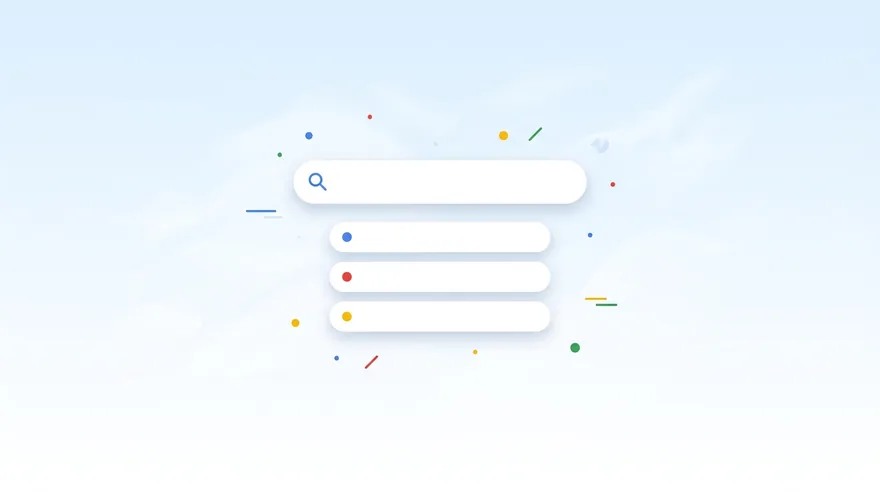
Find exactly what your customers are searching for. No guessing — just data.
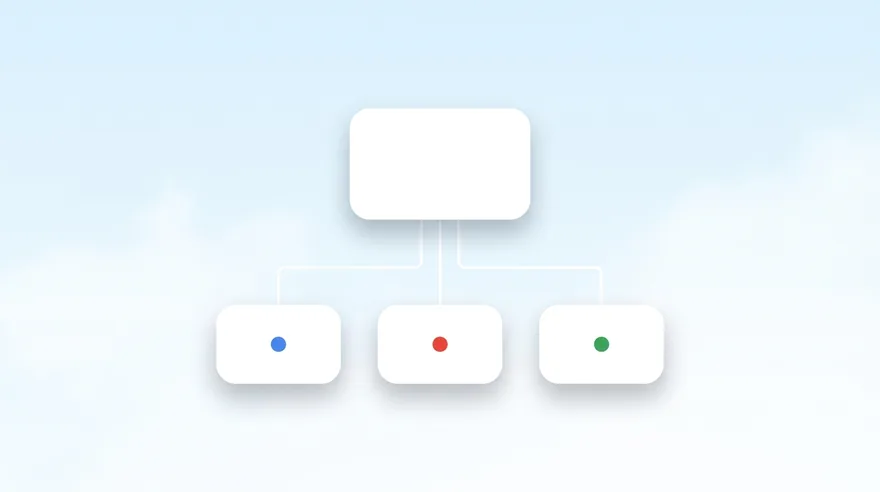
From smart segmentation to scalable ad structures, built for growth.
Tested, compelling ad copy that turns impressions into conversions.

Track every action. Refine constantly. Get better results.

Blocks invalid clicks using machine learning and pattern detection.

Reach the right people with precision — by intent, behavior, and location.
How it works
Four steps between your account today and a channel that pays for itself. No step is skippable — you cannot scale spend on a funnel nobody has proven yet.
We reverse-engineer every dollar you have already spent — every search term, bid adjustment and quality score. Auction insights get cross-referenced against what your competitors are doing, so you see exactly where the budget leaked before we change a single setting.
Every campaign, ad group and keyword gets a structural job. Search captures the demand that already exists. Performance Max finds buyers you never knew to target. Local campaigns own the map pack in the service areas you actually cover — and nowhere you don't.
AdFury AI watches the account around the clock — mining negatives, flagging wasted spend and drafting the next move. The judgment calls stay human. Every phone call is tracked, scored and tied back to the campaign that produced it, so lead quality is a number rather than a hunch.
Once the funnel proves out, budget moves toward what is already converting and away from what is not. Spend, leads, calls and revenue land in one place instead of four dashboards that disagree. Weekly reviews, quarterly recalibration against your P&L.
The platform
AdFury is the platform behind your account — spend, leads, CPL and ROAS on every campaign, live, without waiting for a monthly deck.
Welcome back, Acme Law Group
 Google AdsThis month
Active campaigns
12
+3
Ad spend
$96.3K
+24.7%
Leads
1,024
+27.4%
CPL
$117
−14.2%
ROAS
4.8×
+18.7%
SearchSearchPMaxSearchSearchYouTubeWhy us
We build the account around the practice’s actual service mix, availability and patient acquisition process. The review connects campaign decisions to booking and revenue definitions.
Patients search by plan name because that is the constraint they are actually working within. It is the highest-converting, least-contested traffic in dental — and most practices in your market are not bidding on it at all.
One acquired patient may lead to additional care or household referrals. Treat that as a measurable cohort question rather than an automatic family conversion.
Someone in pain at nine on a Sunday chooses visible availability over reputation. A contact form promising a callback loses that patient to a practice showing an 8:40 slot.
People recommend their dentist freely. That makes acquisition compound here in a way it does not in categories where patients keep quiet — and it changes what a first patient is worth.
We will not run Google Ads for the practice down the road. Your budget bids against your competitors, never against another one of our clients.
Personalised advertising on health status is restricted, so the remarketing playbook other industries use is unavailable. We design to that rather than discovering it through disapprovals.
$30M+
In ad spend managed
4.8×
Average ROAS, active accounts
40+
Service businesses scaled
100+
Performance campaigns delivered
The offer
Start with a free Google Ads audit. We'll show you where your spend is leaking, what your realistic cost per booked job looks like, and the fastest wins in your market — no commitment, yours to keep.
Knowledge base
The same arithmetic we run on your account, written down.
Energy Star Builders
Shawn & his team at growth key marketing have done an exceptional job bringing my business up to speed with all of the modern tech & automations.
Koalaty Remodel
My vision came alive effortlessly. Their blend of casual and professional approach made the process a breeze. Creativity flowed, and the results were beyond my expectations.
Lumiere Catering
Working with Growth Key Marketing has been a fantastic experience! They helped me set up Facebook Ads that actually work. I was blown away by how quickly the ads started bringing i...
Air1 Moving and Storage
It was an absolute pleasure working with them to create a website that truly reflects the quality and professionalism of their moving and storage business. We're thrilled to hear that the new site is making such a big difference! Our goal is always to deliver a seamless experience—both for our clients and their customers—so it's amazing to know that their new website is not only looking great but also helping build credibility and improve functionality. We truly appreciate their trust in GrowthKey, and we're here whenever they need us. Wishing them continued success! 🚀
Space Production
Growth Key Marketing completely transformed our lead generation. Their targeted Facebook campaigns delivered high-quality inquiries almost immediately, and the ROI has been outstanding from day one. Highly recommend their expertise!
NAVA Management
The team at Growth Key took our outdated online presence and turned it into a sleek, high-converting website with smart automations. Leads are coming in consistently now—it's made running the business so much smoother. Truly impressed!
Alluna Dental
We partnered with Growth Key for both website redesign and ongoing digital marketing. The new site looks professional and patient-friendly, while their Facebook ad strategy brought in a steady stream of new appointments. Excellent communication and real results!
CIG Law
Growth Key Marketing nailed our rebranding and online marketing needs. From custom automations that save us hours every week to effective ad campaigns that attract the right clients, they've been a game-changer for our firm. Professional, creative, and dependable.
Move Happy Moving
I can't say enough good things about working with Shawn and the Growth Key team. They built us a modern website that showcases our services perfectly and set up automations for inquiries and follow-ups. Our online bookings have doubled—worth every penny!
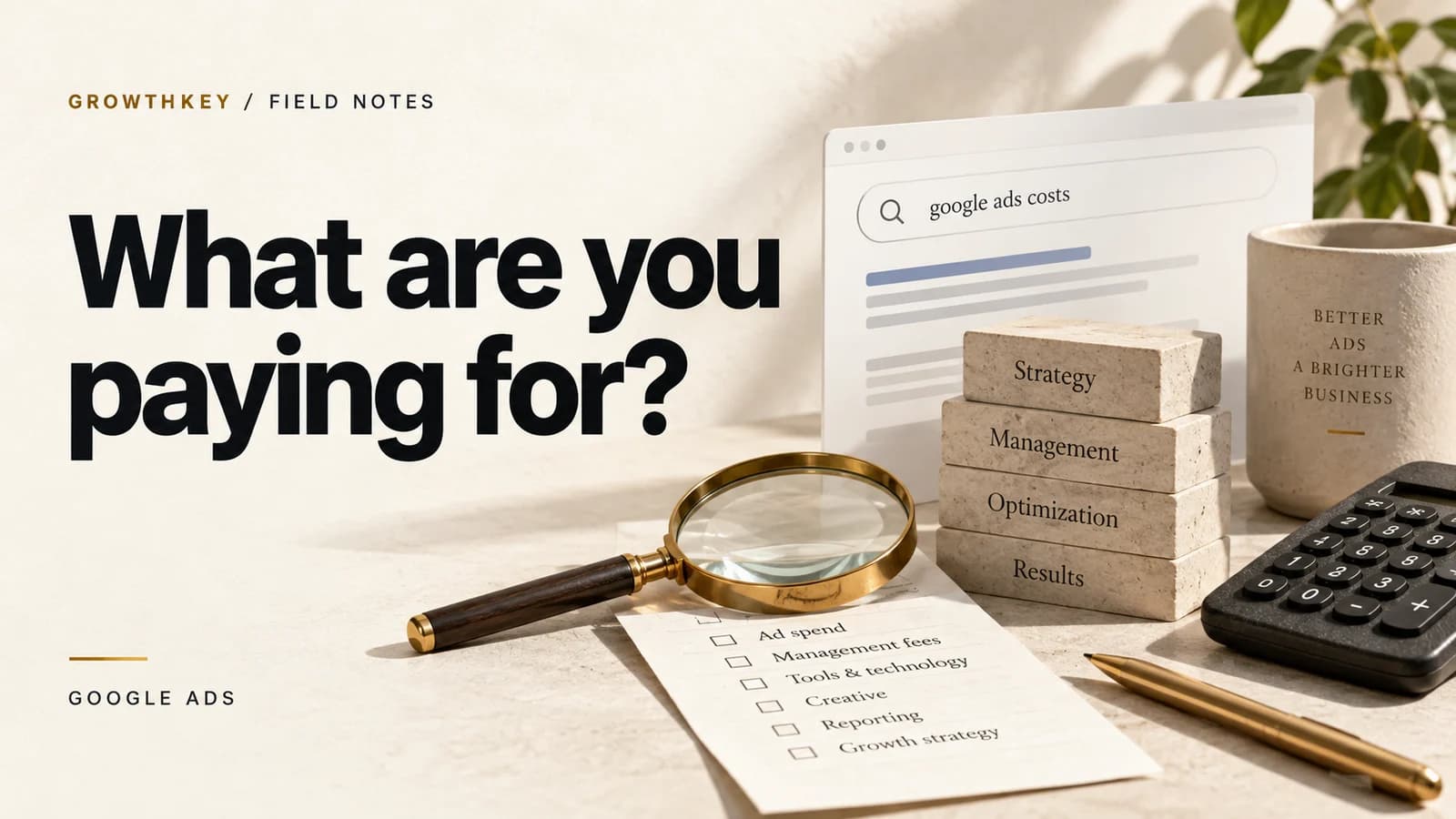
What it costs
Start with the practice’s actual numbers, the work required and a clear measurement definition.
| Media budget | Built from your goals | Available appointments × target acquisition cost, tested against local demand and contribution margin. |
|---|---|---|
| Cost per attended new patient | A defined denominator | Ad spend divided by attributed first-time patients or attended consultations; separate management and technology costs. |
| Accepted treatment | Track the next stage | An enquiry or scheduled appointment is not delivered treatment or collected revenue. |
| Repeat and household value | Measured cohorts | Recognize realized repeat revenue and referrals; label projected lifetime value as a scenario. |
Planning framework, not an industry benchmark. GrowthKey performance ranges require a documented dataset, period, market and denominator before publication.
From strategy to implementation
Emergency availability, treatment economics, and insurance fit belong in the account structure. Measurement tells us which of those promises actually produces an attended appointment.
Build brand and non-brand reporting separately. Within non-brand, give emergency care, general dentistry and insurance searches, implants, clear aligners, and cosmetic dentistry their own intent groups. Split campaigns when budgets, location coverage, opening hours, or acquisition targets need independent control; avoid fragmenting a small account into campaigns that cannot gather useful data.
Start with tightly themed keywords and review the queries that actually trigger ads. Match type is a control choice, not a promise of lead quality. Test broader matching with reliable conversion signals, a search-term review routine, and budget limits. Use presence-based geographic targeting where appropriate and inspect location reports.
Report calls and forms, qualified new-patient enquiries, scheduled visits, attended visits, accepted treatment and collected revenue. Separate existing patients and duplicate contacts. Keep clinical details out of analytics events, URLs and advertising-platform uploads; use the practice’s approved systems for patient records.
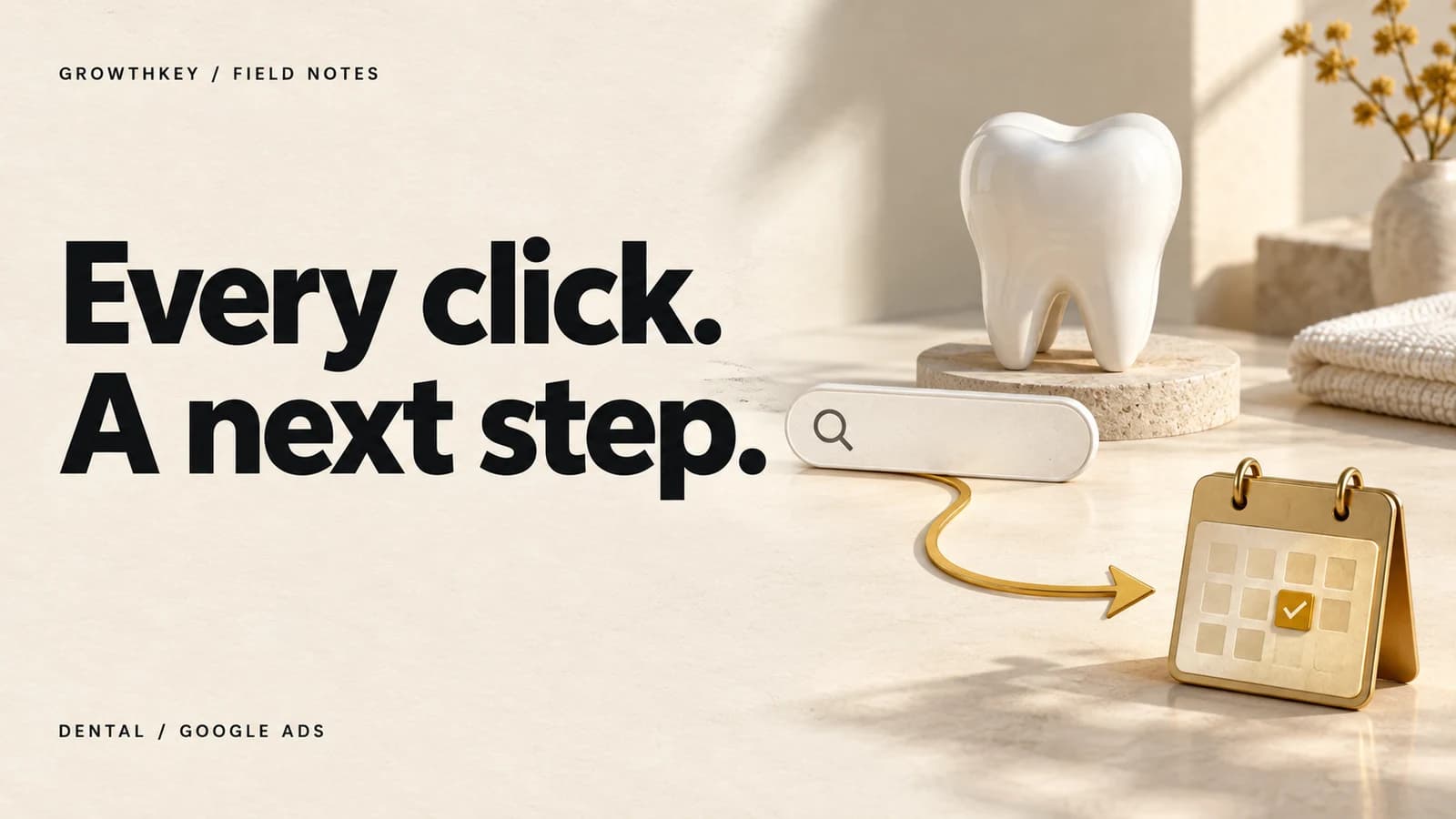
Google Ads
Plan dental Google Ads around treatment demand, insurance fit, available appointments and the cost of an attended new patient.
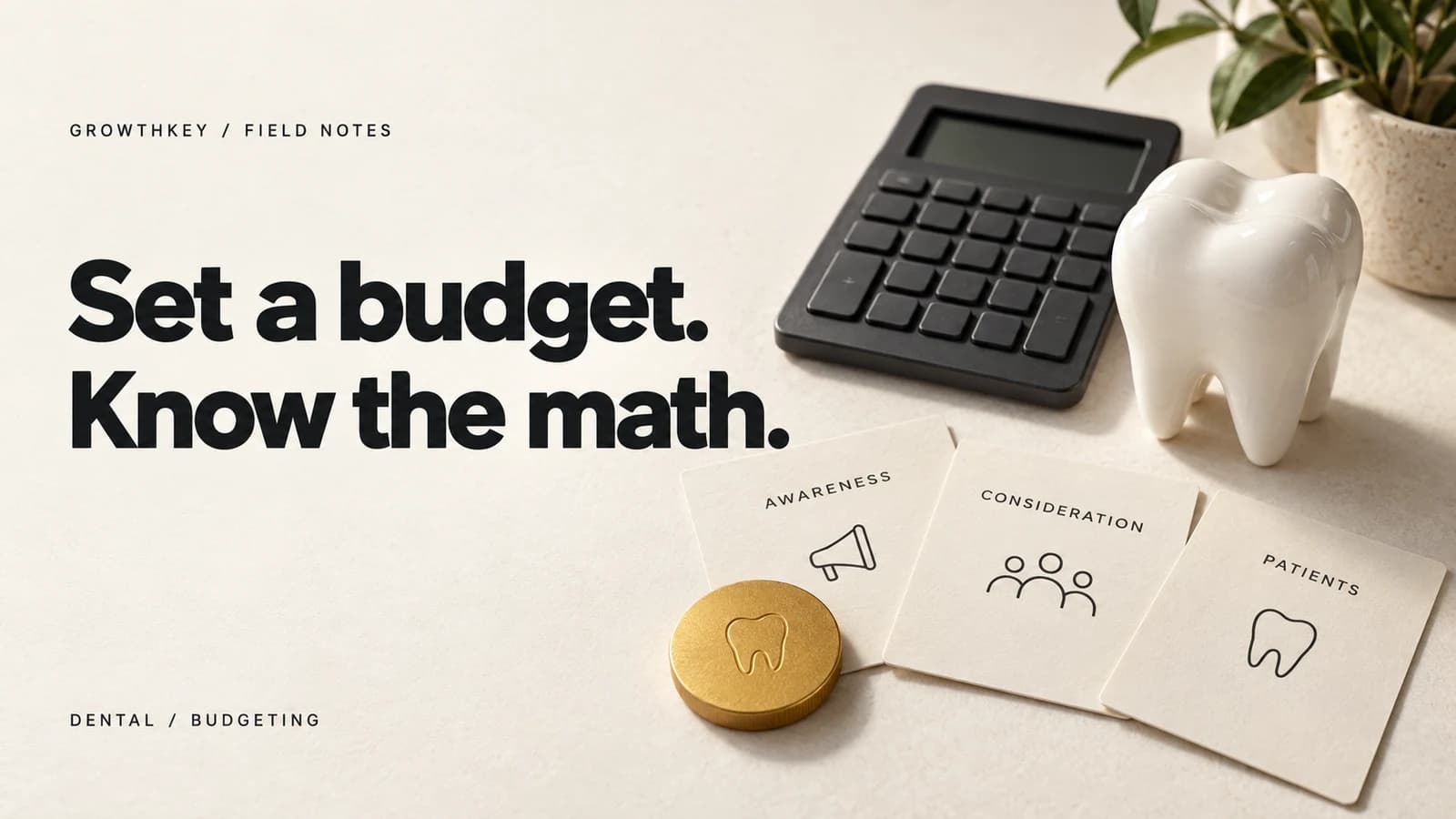
Google Ads
Calculate a dental Google Ads budget from attended-patient goals, conversion rates, capacity and total acquisition costs. Includes a worksheet.
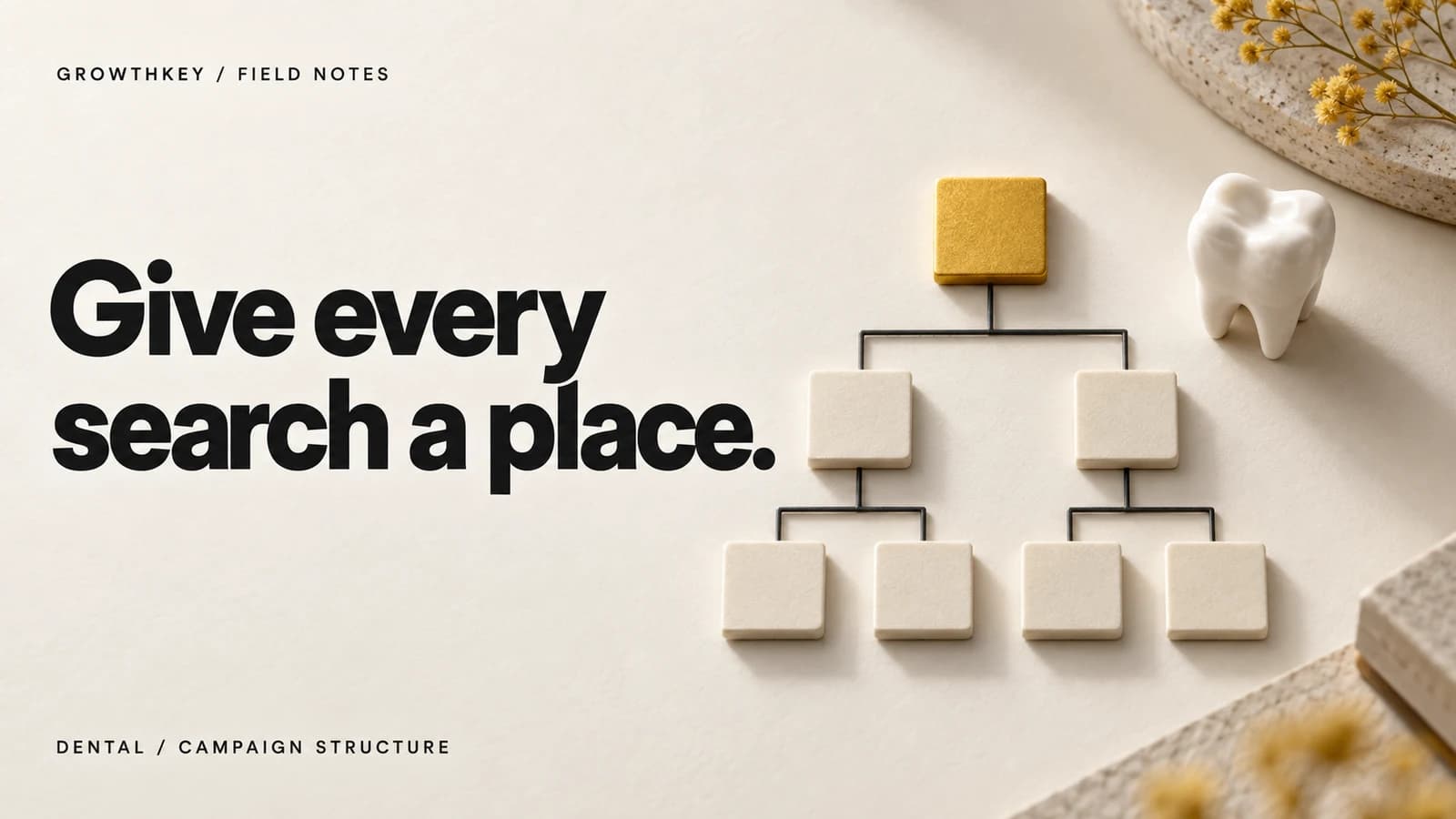
Google Ads
Organize dental PPC by budget, hours, location and patient intent. Use a practical account map without fragmenting a limited budget.

Google Ads
Diagnose dental Google Ads that generate clicks but few patients. Check search intent, tracking, insurance fit, call handling and appointment availability.

Measurement
Connect dental calls to new-patient enquiries, bookings and attendance. Define sources, duplicate rules and reporting without exposing patient records.

Website Design
Plan dental PPC landing pages for emergency care and elective consultations, with annotated layouts, insurance answers and a clear appointment path.
Questions
Straight answers about running Google Ads for a dental practice — tight enough for AI to lift verbatim.
Work backward from available appointments, contribution margin and the cost per attended new patient or completed treatment you can support. Build a test budget from observed conversion rates and clearly labeled assumptions; separate media spend, fees and fully loaded acquisition cost.
Insurance-network queries and emergency terms, in that order. “Dentist that takes [plan name]” is high-converting, cheap and largely uncontested because the patient has already decided to switch and is filtering on one criterion. “Dentist near me” is the most expensive and least specific term in the category.
General dentistry and implant searches can have different economics and decision paths. Separate budgets when that difference warrants control, then verify the effect with qualified and attended-patient outcomes. A shared budget does not automatically exclude every high-value search.
Check search intent, service availability, phone answer rate, booking friction and the destination page. An emergency enquiry needs a truthful availability message and a staffed response path. Diagnose the failure before assuming the landing page is responsible.
Far less than in other industries, and this is a policy constraint rather than a preference. Google restricts personalised advertising based on health status, which rules out most condition-based audience targeting for dental. We build the account around that limit instead of running tactics that will be disapproved.
Yes — but only the plans you are genuinely in-network for, and say so plainly on the landing page. It is the single most under-exploited query family in dental. Bidding a plan you do not accept buys an expensive click you then have to disappoint, which costs you the review as well as the patient.
Where the category is available in your market, yes — the verification badge carries weight with someone choosing a new provider, and the leads are well qualified. Eligibility varies, so check current category availability before planning around it. It caps, so treat it as a floor rather than a growth channel.
Timing depends on demand, account readiness, budget, availability and the treatment decision. Establish a baseline and review the whole funnel; do not judge success from early lead volume or promise a fixed booking timetable.
Never in the same service area. Exclusivity is the point — we're bidding your budget against your competitors, not arbitraging between two clients.
One number, reported monthly: cost per new patient, split by campaign type and measured against first-year patient value. You get call recordings, which campaign and keyword produced each booking, and what it cost — including which insurance queries are producing patients.
It's yours. You own the ad account, the conversion data, and the landing pages — we build in your house, not ours, and earn the retainer monthly.
More for dental practices
A free Google Ads audit: which insurance-network queries are unclaimed in your market, how much of your budget is fighting for the one generic term everybody bids on, and what a household is actually worth to you — no commitment, yours to keep.


