
Energy Star Builders
Shawn & his team at growth key marketing have done an exceptional job bringing my business up to speed with all of the modern tech & automations.
Built around patient decisions
The first question most new patients have is whether you take their insurance.The second is whether they can get in this week. Both are answered by a phone call that has to happen during working hours — while the patient is also at work.So they book with the practice whose website answered both.
Partner
Meta
Partner
Partner
TikTok
Partner
Partner
Meta
Business Partner
Certified Marketing Partner
TikTok
Marketing Partner
Website design for dental practices is the practice of building a site that functions as front-desk capacity rather than as a brochure — answering the insurance question in public, letting a new patient book without a phone call, and educating high-value cases like implants or orthodontics long before they are ready to enquire. It is judged on whether insurance and cost are answered on the page, whether booking reaches the practice-management system rather than an inbox, and whether forms and tracking are configured for a HIPAA context rather than a generic one.
Which plans are accepted, what happens if a plan is out of network, and what a visit costs without insurance. The first question of most new patients, and the one most practice sites decline to answer.
Real availability written into the practice-management system, not a request form that a member of staff re-keys the next morning. A new patient searching at 9pm cannot phone you.
Implants, full-arch and orthodontics are five-figure decisions taken over weeks. The page that explains the process, the alternatives and the financing is what makes the consultation happen.
The gap
A new patient who cannot find out whether you take their plan does not send an enquiry saying so. They go to the practice whose site listed it. That loss is invisible in every report you have — no missed call, no abandoned form, nothing to review — which is exactly why it persists for years in practices that are otherwise well run.
The same is true of the five-figure case. An implant patient who cannot find out what the process involves, what the alternatives are, or whether it can be financed does not book a consultation to ask. They keep reading, on someone else's site, until one of them explains it — and the practice that explained it is the one that gets the case.
What it's costing you
This is when a large share of new-patient searching actually happens — outside the hours in which your practice can answer anything.
About four minutes, entirely outside your opening hours
New in the area, or a tooth has started to hurt, or a child needs a first visit. Whatever brought them here, the first filter is not quality — it is whether their insurance works with you.
'We accept most major insurances' answers nothing. The patient cannot tell whether that includes theirs, and there is nobody to ask until tomorrow morning, when they will be at work.
A request that somebody will respond to during business hours is not a booking. It asks the patient to stay interested overnight, and a meaningful share of them do not.
Two tabs over is a practice that listed the plan and showed Thursday at 2pm as available. That practice has just acquired a patient worth years of recall, hygiene and eventual restorative work, and it never spoke to them.
Your website is your front desk for the two thirds of the week the real one is closed. Most practices staff it with a contact form.
What your site has to do
Dental templates are plentiful and they are all built around the same brochure. Here is where a practice is not a brochure.
The actual plans you accept, listed. What happens if a patient is out of network. What a new-patient exam costs without insurance. 'We accept most major insurances' is not an answer and every patient reading it knows that.
The most resisted recommendation on this trade and the one that most reliably moves new-patient volume. The fear is being filtered out on plan; the reality is being filtered out already, silently, by patients who could not tell.
Real availability, written into Dentrix, Open Dental, Eaglesoft or whichever system you run. A request form that a team member processes the next morning is not booking — it is a delay dressed as convenience.
Most new-patient searching happens outside your opening hours. The website is the only part of the practice open then, and a contact form staffs it with nobody.
Implants, full-arch, orthodontics and cosmetic work are decisions taken over weeks, with real fear attached and a financing question underneath. What the process involves, the alternatives, recovery, longevity, and what it costs.
This path does not convert with a booking button — it converts with an explanation. A practice that publishes real case education gets consultations from patients who arrive already halfway convinced, which is a different and much better conversation.
Forms, chat widgets, analytics and advertising pixels all touch information that has rules attached in this context. Configured properly, with the vendors' terms in place and nothing capturing what it should not.
A themed site with a stack of third-party plug-ins is a compliance surface no one is monitoring, added to one plug-in at a time. Hand-coding is partly a legal argument here, not only a performance one.
Forms completed before arrival, recall and rescheduling, payment, post-operative instructions, referral. A large share of your traffic is people who already chose you, and serving them is front-desk time returned to the practice.
The least glamorous item here and the one your team will notice first, because it converts phone minutes into chair time.
The proof
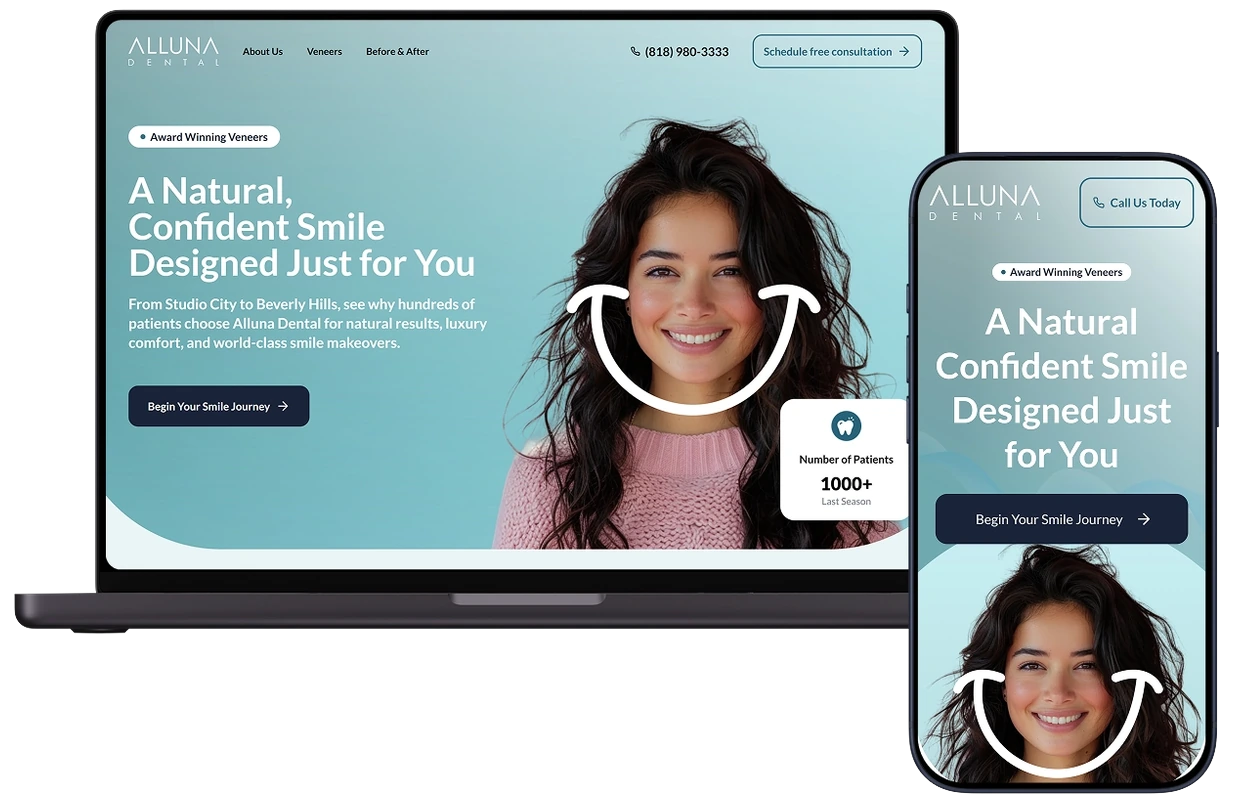
Alluna Dental
Dental practice · Website redesign + paid social
Alluna Dental came to us for a website redesign and ongoing marketing. The figures below are theirs, published, and they are the reason this page can argue about conversion rather than about taste.
Rebuilt the landing page with insurance-match messaging, a shorter appointment form, and patient reviews above the fold. Tested three calls to action to turn more visits into bookings.
Conversion rate
Cost per lead
Monthly bookings
Our Approach
Most agencies start from a WordPress theme. We build every site from scratch in Next.js — so it loads fast, ranks, and is built around getting you calls.
| Compared on | Custom Growth Key buildHand-built. Tuned for leads. | Typical template sitePre-built. Hard to grow. |
|---|---|---|
| Speed | Custom Growth Key buildFast on a phone — built to pass Google’s Core Web Vitals | Typical template siteSlowed down by heavy themes and plug-ins |
| Design | Custom Growth Key buildDesigned around your offer and your customers | Typical template siteBoxed in by the template’s layout |
| Leads | Custom Growth Key buildCalls, forms and tracking built in from day one | Typical template siteBuilt for easy setup, not for bringing in work |
| Upkeep | Custom Growth Key buildClean code — no plug-ins to patch or break | Typical template siteConstant plug-in updates, conflicts and security fixes |
| Growth | Custom Growth Key buildNew services, locations and pages slot straight in | Typical template siteOne-size-fits-all structure that fights every change |
| Ownership | Custom Growth Key buildYou own the code, the domain and the data | Typical template siteLocked to a theme, a page builder or a platform |
How It Works
Six to eight weeks from kickoff to launch. The order is the point — you cannot design a page before deciding what it has to say, and you cannot improve one you never instrumented.
Before anything gets designed we work out what the site has to say and who it has to say it to — your offer, the objections that lose you jobs, and the words your best customers actually use. Most redesigns fail here, not in the design phase: a beautiful page built on a vague message is just a faster way to lose the lead.
Hierarchy before pixels. We map what a visitor sees first, where the proof sits relative to the ask, how many fields stand between interest and a submitted form, and what the call path looks like on a phone. You approve the skeleton while it is still cheap to change.
Hand-coded on a modern stack — no themes, no plug-in stack to maintain, no page builder deciding what your site can do. Fast by construction rather than by later optimization, and yours outright: the design, the content, and the code, with a handoff any developer can pick up.
Tracking is wired before go-live, not bolted on after — form events, call tracking, and the source that produced each one. Then the site stops being a deliverable and becomes a starting position: we watch what real visitors do and rebuild whatever the data says is lying.
What it costs
Start with the practice’s actual numbers, the work required and a clear measurement definition.
| The commercial case | Your current funnel | Baseline qualified traffic, booking requests, confirmed appointments and attendance. |
|---|---|---|
| Build scope | Treatment + location | Price against page needs, booking integration, content, accessibility and privacy requirements. |
| Conversion improvement | Test, then measure | Use comparable traffic and a defined conversion event; do not assume a percentage lift. |
| Long-term value | Collected revenue | Evaluate repeat visits and memberships after delivery costs, refunds and retention. |
Planning framework, not an industry benchmark. GrowthKey performance ranges require a documented dataset, period, market and denominator before publication.
Why us
We have rebuilt this exact site before, for a practice, with the numbers published — which is a claim most agencies in this category cannot make.
The most resisted recommendation on this trade and the one that most reliably moves new-patient volume. Patients are already filtering you out; they are just doing it silently.
Dentrix, Open Dental, Eaglesoft, Curve. Real availability, not a request form somebody processes tomorrow morning while the patient is at work.
Implants and full-arch convert on explanation. The consultation you want is the one where the patient arrives already halfway there.
Forms, chat, analytics and pixels configured deliberately rather than accumulated one plug-in at a time with nobody watching the total.
Design, content, code, hosting, analytics. Which is not the norm in dental, where a great many practice sites are rented from a vendor and leave with them.
$30M+
In ad spend managed
4.8×
Average ROAS, active accounts
40+
Service businesses scaled
100+
Performance campaigns delivered
The offer
Start with a free website audit. We'll show you where your current site loses people — the pages they leave from, the friction in the form, what it costs on mobile — and what a rebuild would and would not fix. No commitment, yours to keep.
Energy Star Builders
Shawn & his team at growth key marketing have done an exceptional job bringing my business up to speed with all of the modern tech & automations.
Koalaty Remodel
My vision came alive effortlessly. Their blend of casual and professional approach made the process a breeze. Creativity flowed, and the results were beyond my expectations.
Lumiere Catering
Working with Growth Key Marketing has been a fantastic experience! They helped me set up Facebook Ads that actually work. I was blown away by how quickly the ads started bringing i...
Air1 Moving and Storage
It was an absolute pleasure working with them to create a website that truly reflects the quality and professionalism of their moving and storage business. We're thrilled to hear that the new site is making such a big difference! Our goal is always to deliver a seamless experience—both for our clients and their customers—so it's amazing to know that their new website is not only looking great but also helping build credibility and improve functionality. We truly appreciate their trust in GrowthKey, and we're here whenever they need us. Wishing them continued success! 🚀
Space Production
Growth Key Marketing completely transformed our lead generation. Their targeted Facebook campaigns delivered high-quality inquiries almost immediately, and the ROI has been outstanding from day one. Highly recommend their expertise!
NAVA Management
The team at Growth Key took our outdated online presence and turned it into a sleek, high-converting website with smart automations. Leads are coming in consistently now—it's made running the business so much smoother. Truly impressed!
Alluna Dental
We partnered with Growth Key for both website redesign and ongoing digital marketing. The new site looks professional and patient-friendly, while their Facebook ad strategy brought in a steady stream of new appointments. Excellent communication and real results!
CIG Law
Growth Key Marketing nailed our rebranding and online marketing needs. From custom automations that save us hours every week to effective ad campaigns that attract the right clients, they've been a game-changer for our firm. Professional, creative, and dependable.
Move Happy Moving
I can't say enough good things about working with Shawn and the Growth Key team. They built us a modern website that showcases our services perfectly and set up automations for inquiries and follow-ups. Our online bookings have doubled—worth every penny!
From strategy to implementation
The website should help a patient check fit, trust the provider and choose a workable next step. The right design connects treatment and insurance information to the practice’s real scheduling process.
Use search → trust → insurance check → treatment research → provider evaluation → availability → booking as the core path. Emergency patients need clear hours and click-to-call access; planned treatments need useful procedure pages and consultation information. A booking request must not look like a confirmed appointment.
Explain accepted plans and network status accurately, link financing details with relevant terms, and publish useful provider biographies. Each location needs directions, parking or access information, hours and its own booking destination. Treatment and location pages should link to one another naturally.
Use the minimum information needed on public appointment forms. Send clinical histories and sensitive details through the practice’s approved secure intake system. Assess vendors, data flows and agreements with the practice’s privacy owner; HTTPS alone is not HIPAA compliance.

Website Design
Plan dental PPC landing pages for emergency care and elective consultations, with annotated layouts, insurance answers and a clear appointment path.

Google Ads
Diagnose dental Google Ads that generate clicks but few patients. Check search intent, tracking, insurance fit, call handling and appointment availability.

Measurement
Connect dental calls to new-patient enquiries, bookings and attendance. Define sources, duplicate rules and reporting without exposing patient records.
FAQ
Straight answers about rebuilding a dental website — insurance, booking, HIPAA, case education, and what it will not fix.
Yes, and it is the recommendation practices resist most. The fear is being filtered out by plan; the reality is that you are already being filtered out — silently — by patients who could not tell and went to the practice that said. 'We accept most major insurances' answers nothing, and every patient reading it knows that.
It is usually the single largest conversion gain in the rebuild. Most new-patient searching happens in the evening, when your front desk is closed — the website is the only part of the practice open, and a request form staffs it with nobody. Real availability written into your practice-management system is booking; a form is a delay.
Yes. Booking, new-patient forms and recall connect to the practice-management system you already run — Dentrix, Open Dental, Eaglesoft, Curve and the common alternatives, typically through your existing scheduling platform — so an online booking becomes a real appointment rather than an email.
Yes, and it is under-audited. Forms, chat widgets, analytics and advertising pixels all touch information that has rules attached in this context, and a themed site accumulates those one plug-in at a time with nobody monitoring the total. We build with that constraint in the specification rather than discovered afterwards — and we are web developers, not your compliance counsel, so anything with legal consequence is confirmed with yours.
By explaining rather than offering. These are five-figure decisions taken over weeks, with real fear and a financing question underneath. A page covering process, alternatives, recovery, longevity and cost produces consultations from patients who arrive already halfway convinced — which is a much better conversation than one that starts at the beginning.
The rebuild's job is conversion — what happens to visitors you already have. Paid search, paid social and Local SEO are what create the visits. That said, real case-education pages can rank for questions a brochure site was never eligible for, so there is some traffic effect on the high-value path.
The schedule depends on content readiness, integrations, review and migration scope. We agree milestones after checking the booking system and the materials the practice can provide.
It depends on scope — number of service and case-education pages, scheduling integration, locations — and we quote after the audit. The figure to establish first is how many new patients per month the current site loses on the insurance and booking questions, valued over their lifetime rather than their first visit.
Entirely. Design, content, code, hosting and the analytics account, transferable on the day you ask. No proprietary builder and no licence that stops working if you leave — which matters more in dental than most trades, because a large share of practice sites are rented from a dental-specific vendor.
Tracking wired before launch, so there is a clean before and after on the same traffic. We report booked appointments separately from calls and forms, and separate new-patient bookings from existing-patient activity — because averaging them hides whether acquisition actually improved.
More for dental practices
A free website audit: whether a new patient can find their plan, whether they can actually book, what happens to your implant and ortho traffic, and how many patients per month the gap is worth — no commitment, yours to keep.
No pitch deck. Clients average 4.8× ROAS.


