Google Ads / Dental Marketing / Campaign Structure
Dental PPC campaign structure: what to separate and what to combine
Organize dental PPC by budget, hours, location and patient intent. Use a practical account map without fragmenting a limited budget.
In this article
- Split a campaign when a business decision needs its own control
- Decide which level should own each setting
- Give emergency and routine acquisition different operating rules
- Protect elective-treatment budgets when the economics justify it
- Keep brand and insurance intent visible
- Use exclusions to manage overlap without blocking good patients
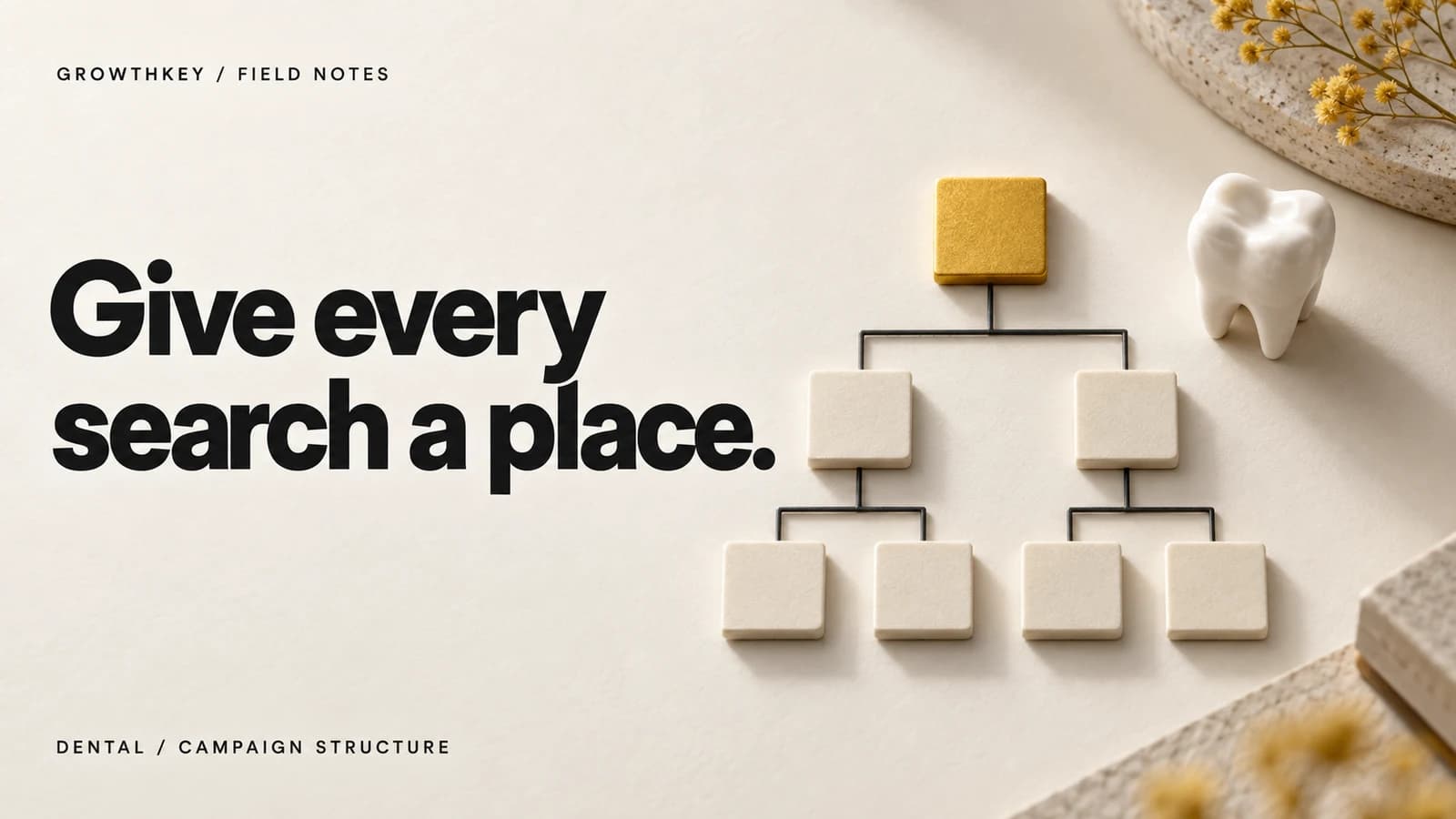
- Use an account map that exposes ownership
- Know when fragmentation has become the problem
- Check the account before the first paid click
- Use the structure to make a better decision
- Frequently asked questions
Split a campaign when a business decision needs its own control
A useful dental PPC campaign structure separates work that needs a different budget, geographic reach, schedule or acquisition target. Ad groups organize closely related searches, ads and destination pages within those boundaries. Treatment names alone do not determine how many campaigns a practice needs.
A single general-services campaign can conceal important differences between urgent visits and elective consultations. The opposite extreme, a separate campaign for every keyword variation, can divide a small budget into pieces that reveal very little. Build the smallest structure that lets the practice make the decisions it actually faces.
This article is an account-design walkthrough for U.S. practices. The account map is illustrative and is not a screenshot or description of a GrowthKey client account. Use the dental Google Ads guide for the complete acquisition process and the budget guide to test whether the proposed scope can be funded.
Decide which level should own each setting
Start with a written control map. If two services need independent spending limits, separate campaign budgets can protect that decision. If they share the same budget owner, operating hours, location and outcome, separate ad groups may be enough. Shared budgets are an explicit choice to let campaigns draw from a common pool; they do not preserve independent spending limits.
Within a Search campaign, each ad group should describe a coherent visitor decision. Avoid a group containing an emergency appointment, an implant consultation and a routine cleaning simply because they all involve teeth. The ad and page should be able to answer the whole group honestly.
| Question | Likely level | Reason |
|---|---|---|
| Must this service keep a protected budget? | Campaign | Separate budget ownership can prevent another service consuming its allocation |
| Does this office have different hours or geography? | Campaign | Delivery must match that office's operating boundaries |
| Do these searches need a different message or page? | Ad group | A distinct intent can need different creative without a separate budget |
| Are these spelling or wording variations of one decision? | Keyword review within the group | More groups do not necessarily create more useful control |
| Does this visitor represent an existing patient? | Practice-side classification and reporting | Campaign names cannot establish new-patient status |
Give emergency and routine acquisition different operating rules
Emergency demand often exposes an operational constraint before a media constraint. A practice may reserve urgent slots only on selected days or answer calls only during staffed hours. If the emergency promise cannot be maintained under the routine campaign's settings, it needs independent delivery control.
Routine new-patient acquisition can focus on location, provider trust, the first-visit process and insurance questions. Its destination should make an appointment request easy without implying immediate availability. Keeping these messages apart makes it easier to see whether the front desk is receiving the requests the practice intended to buy.
Write a rule for the last available slot
Suppose an office has two urgent appointments left today. The practice manager should know how to notify the campaign owner when those slots are gone. Depending on the offer, the response might be to pause the urgent campaign, change the availability message or route to another accurately represented location. A permanent 'same-day' headline is not a capacity-management system.
Test the actual phone route
Call the displayed number during the advertised hours and verify the destination. Test what happens when nobody answers and when a call arrives near closing. Use appropriate permissions and privacy controls for any recording. A functioning forwarding number proves routing; it does not prove a new patient was booked.
Protect elective-treatment budgets when the economics justify it
Implant, clear-aligner and cosmetic consultations may need a distinct page, a longer evaluation window and a different acquisition ceiling from general care. A dedicated campaign can make that investment visible when the practice has enough capacity and budget to evaluate it. It should not be created merely to make the account look specialized.
Use separate ad groups for genuinely different consultation decisions. A person comparing clear aligners needs different information from someone seeking an implant assessment. Keep provider information, the consultation process and financing context aligned with the request; do not use treatment revenue as if every enquiry will produce an accepted and completed case.
When volume is limited, choose which service to test first. Consolidating two economically similar themes under one campaign can simplify budget management while preserving distinct pages. Combining unrelated themes into one ad group to manufacture volume usually sacrifices the relevance the segmentation was meant to create.
Keep brand and insurance intent visible
A separate brand campaign or clearly separated brand reporting helps distinguish people looking for the practice from broader acquisition demand. It does not establish incrementality: some branded visitors might have found the practice without a paid ad. It also does not establish new-patient status, because returning patients use search to find contact details.
Insurance-led searches can sit in relevant general-care ad groups when the office, budget and next step are the same. Separate them when a genuine operational or economic reason requires different control. In either case, assign an owner to verify the exact plan and network language. Do not turn the carrier's name into a promise that every plan is in-network.
Plan a route for searches that combine intent, such as a named insurer and emergency dentistry. The appropriate destination must explain both the urgent availability and the insurance-verification step. If the practice cannot honor one part of that promise, a campaign split cannot solve it.
Use exclusions to manage overlap without blocking good patients
Start with a record of irrelevant intents: employment, training, equipment, services not offered and other clearly unsuitable searches. Decide whether each exclusion belongs across the account, in one campaign or in one ad group. An account-wide exclusion is a broad business rule, so apply it more cautiously than a local routing decision.
Google's negative-keyword guidance explains that negatives do not automatically expand to close variants. Maintain the variants that matter and review newly observed searches. Do not assume that an extensive negative list proves the account is controlled.
Cross-campaign negatives can help route an intent to its intended campaign, but test the consequences. If the destination campaign is paused, out of budget or ineligible, an exclusion elsewhere may mean the search is not served at all. That can be the right decision for closed emergency capacity; it should be intentional.
Cost and financing questions are not inherently poor-quality leads. A person comparing affordability may still be a suitable patient. Classify the outcome before turning those words into blanket exclusions. The issue may be an unclear financing page or an unrealistic ad promise rather than the search itself.
Use an account map that exposes ownership
The example below describes one location with routine availability, some urgent capacity and a funded implant-consultation test. An office without those conditions should remove the unnecessary rows. Campaign names are internal labels, not patient data.
Use a consistent naming pattern such as location / network / demand / intent. Keep patient identities and clinical details out of names, URLs and campaign parameters. Reporting labels should make operational decisions easier without carrying sensitive information into marketing tools.
| Campaign | Ad-group intent | Destination | Outcome and owner |
|---|---|---|---|
| Main office / Search / Brand | Practice and provider navigation | Location or provider page | Classify new versus existing enquiries; practice manager |
| Main office / Search / General | New dentist; verified plan enquiries | Relevant first-visit or insurance page | Attended first visits; front desk and marketing lead |
| Main office / Search / Emergency | Urgent local appointment | Current urgent-care availability page | Appropriate attended visits; scheduling owner |
| Main office / Search / Implants | Implant consultation | Implant consultation page | Attendance, acceptance and collections tracked separately; treatment coordinator |
Keep the conversion goal as explicit as the campaign name
Inspect the goals selected for each campaign. Google's conversion-goal documentation distinguishes standard and custom goals; an event can affect bidding because of the goal configuration, not merely because the team gave it a reassuring name. Keep internal patient-outcome reporting separate from the approved advertising signal. Adding a campaign is not permission to add patient data to a platform.
Review location settings alongside the map
A geographic label in a campaign name does not enforce its reach. Check the actual location options and exclusions, then reconcile where appropriate enquiries originate. Presence targeting can support a local-visit objective, but it is an estimate and should be evaluated against actual outcomes.
Know when fragmentation has become the problem
Warning signs include several campaigns spending too little to produce useful observations, the same query appearing across redundant ad groups, and a reporting meeting that cannot identify what decision a split supports. Do not use a universal conversion-count threshold as a substitute for understanding volume, lag and signal quality.
Consider consolidating campaigns when their location, hours, outcome definition and economics are genuinely aligned. Preserve the relevant ad groups and pages, record the change date, and avoid simultaneously replacing the budget, bid strategy and creative. That makes the before-and-after interpretation less ambiguous.
When adding standard Performance Max, review how it overlaps with Search instead of assuming Search always receives every relevant query. Google's matching and prioritization explanation includes eligibility and relevance conditions. Also inspect destination expansion controls so automated reach does not undermine the page map.
Check the account before the first paid click
Run a practical launch review with the practice manager and whoever answers enquiries. The goal is to verify the complete route, not just that each campaign has a green status. Then give each review task an owner and a next check date.
- Scope: Every advertised treatment exists at the named location, and the practice wants the kind of appointment being promoted.
- Control: Budgets, location options, schedules, brand handling and exclusions match the written account map.
- Promise: The ad, page, insurance wording and availability are consistent and current.
- Handoff: Phone and form routes work on mobile; appointment requests are not labeled as confirmed bookings.
- Measurement: Events are not duplicated, campaign goals are intentional, and patient information remains inside approved workflows.
- Ownership: Someone can act on missed calls, wrong-fit enquiries, exhausted capacity and policy disapprovals.
Use the structure to make a better decision
A well-organized account lets the practice explain where money went, which enquiries it bought, what happened next and what should change. The value of the structure is the decision it enables. A more elaborate hierarchy is not evidence of better management.
For implementation and ongoing review, see GrowthKey's dental Google Ads service. If the missing piece is the destination rather than the campaign, review dental website design before adding more traffic.
Frequently asked questions
Should each dental treatment have its own campaign?
Only when it needs campaign-level control such as a separate budget, schedule, location or economic target. Distinct ad groups and landing pages may provide enough relevance when those controls are shared.
Should brand searches have a separate campaign?
Separate brand reporting is useful because it describes different demand from non-brand acquisition. A dedicated campaign can simplify that separation. Still distinguish existing from new patients in practice-side reporting and do not assume branded conversions are incremental.
Can a small budget support treatment segmentation?
Yes, but the scope may need to be narrow. Start with a service the practice can evaluate meaningfully. Preserve useful ad-group relevance while avoiding a long list of independently funded campaigns with little activity.
How often should dental negative keywords be reviewed?
Review them closely during launch and after scope changes, then maintain a recurring cadence based on traffic and risk. Check both irrelevant searches that slipped through and relevant searches that a broad exclusion may have blocked.
When should dental campaigns be consolidated?
When their operating constraints and outcome definitions align and separate budgets no longer support a useful decision. Record the change and preserve a stable comparison period; consolidation alone does not fix weak pages or poor appointment handling.
Sources & further reading
Are your leads becoming customers?
Let’s review your campaigns, tracking, and the steps between a click and a customer. Get a clear view of what to fix first.
- Your business, your numbers
- Practical next steps
- A conversation with our team
No commitment. Yours to keep.